


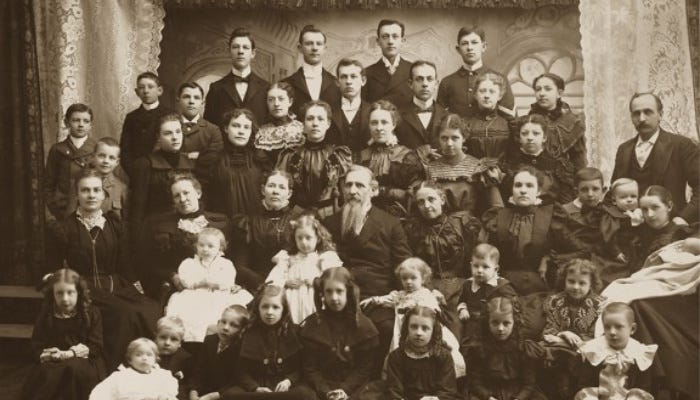
My sudden obsession with 19th-century Mormon polygamy may certainly feel a little odd; it did a little to me. The obvious explanation is that it lines up with the start of my master’s thesis, which uses polygamy as a case study to explore early American constitutionalism, jurisprudence, and the free exercise clause.
“Polygamy” is a loaded word, and it carries strong emotions and opinions; and for good cause. For many of the women who lived it, the practice brought real hardship and trauma. The modern application of the practice is a criminal act, and very public examples in the media demonstrate its close association with manipulation and abuse. And aside from the cultural aspects of polygamy, there is also a robust theological debate about its history and divine nature that extends across history and around the world; far beyond just 19th-century Mormonism.
All of that intentionally remains outside of the scope of my research and writing. My focus is on a different part of the story: the legal one.
The truth is, Polygamy was an objectively legitimate religious practice, but it was antithetical to the moral and cultural norms of the country at the time. And during a time when the federal government had very limited power over individual rights, they were forced to confront the issue head-on. Not only are there numerous historical-legal lessons to learn from the ensuing conflict, but modern-day free exercise doctrine is built upon it.
In 1856, the Republican Party’s national platform declared it the duty of Congress to prohibit “twin relics of barbarism” in the territories. These were slavery and polygamy. The party organized to stop the spread of human bondage gave plural marriage equal billing on the list of things the republic could not survive. For nearly forty years, from the Latter-day Saints’ public announcement of the principle in 1852 to their surrender in 1904, polygamy sat near the center of American politics, and the campaign against it built legal machinery the country still runs on. The case for studying it does not rest on one argument but on many:
It produced America’s first doctrine of religious freedom, and the doctrine still governs. The Free Exercise Clause sat undefined for almost ninety years because no case forced the question. Polygamy forced it. Reynolds v. United States (1879) drew the line between protected belief and punishable action and carried Jefferson’s “wall of separation” into constitutional law. That frame still runs through Employment Division v. Smith, the Religious Freedom Restoration Act, and every current fight over religious exemptions.
It gave marriage its constitutional definition. To outlaw the alternative, the Court had to say what marriage is, and it answered: a public institution, the seedbed of the state, not a private contract. Loving and Obergefell argue inside that premise, and polygamy remains the hypothetical court’s reach for when testing marriage’s outer edge. A dead practice still does live doctrinal work.
The panic, not the practice, is the anomaly. Most societies in the human record permitted plural marriage; enforced monogamy is the exception. Yet one small territory’s marriages drew four decades of national campaigning. Disproportion on that scale means the fight was about sacred commitments rather than numbers, which makes it a probe into what America actually held holy.
It marks the outer limit of lawful state power against religion. Escalating statutes, more than a thousand imprisonments, corporate dissolution, property seizure, suffrage revoked, and every step upheld by the Supreme Court. No mob and no aberration: the system itself did it, so the episode is a test of the system. Nothing comparable has happened to any other religious practice or institution.
It isolates religion as the variable. The targets were white, native-born Christians, so the usual engines of American persecution, race and foreignness, were absent. Chief Justice Waite’s opinion still reached for civilizational hierarchy, locating polygamy among the peoples of Asia and Africa. Watching the machinery of “othering” get built against the in-group exposes how that machinery works.
It is a clean experiment in federal power. Utah was a territory, so congressional authority ran at full strength with no federalism buffer, and statehood itself became the leverage. The targets were a local majority but a national minority, which inverted the usual arithmetic of majority rule. The campaign shows what Washington can do when nothing checks it.
It is the textbook case of majority tyranny executed lawfully. A democratic majority destroyed a religious minority’s institution by statute, ballot, and court without breaking a single rule. Tocqueville and Mill warned about the condition in theory and the anti-polygamy campaign provided the proof.
It wrecks the standard narrative of gender and rescue. Utah women had voted since 1870, among the first in the nation, and used the franchise to defend plural marriage in mass meetings. Congress answered in 1887 by taking their votes away. Victims who refused rescue, and rescuers who disenfranchised them, are both in the record.
It shows the moral establishment operating in the open. Nominally neutral law enforced a Protestant moral consensus and called the result neutrality. In Davis v. Beason (also a major part of my thesis), courts went further and punished membership itself, deciding which faiths count as religion and which count as crime dressed in religion’s clothes.
It is one of the only church-state conflicts that ran to completion. The arc has dates: announcement in 1852, escalation, the Manifesto in 1890, statehood in 1896, and assimilation from national menace to model citizen within a generation. History rarely closes its experiments. This one closed, so what surrender cost, and what it bought, can actually be measured.
It can be studied from every angle at once. Both sides kept obsessive records: church archives and trial transcripts, congressional debates and pulp anti-Mormon novels, sermons and cartoons, and the women’s own papers. Documentation this dense, from inside a persecuted group as well as outside it, is rare for any century.
Taken together, these add up to something close to a controlled experiment, which is the rarest thing history offers. One variable isolated, maximum state power applied, first-impression rulings forced, both sides documented to the page, and the whole arc closed with a dated ending. American legal history holds nothing else like it. A nation’s statutes are a ledger of its judgments, but its prosecutions are a confession of what it holds sacred, and the case against polygamy is one of the longest confessions America ever wrote. It repays reading in full, prosecutors, defendants, and the women everyone claimed to speak for, because the hand that wrote it has never entirely put down the pen.
I look forward to sharing my research and writing on this subject in the coming months. Please feel free to ask any questions or share any thoughts you might have. Bryan@OnPolicyAndReason.com.