


*I presented this essay at the 2026 Mormon History Association Annual Conference.
I. Introduction
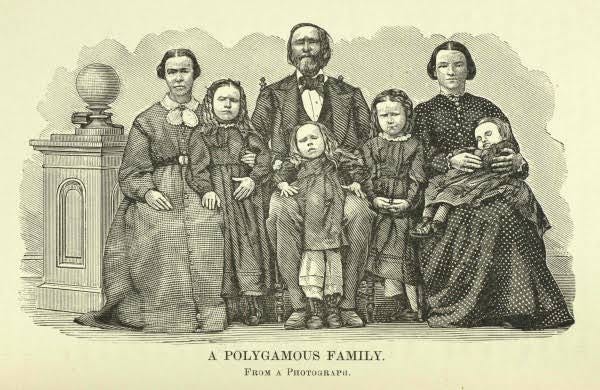
The American civil rights canon records a recognizable set of constitutional abuses. The enslavement of Black Americans denied personhood itself and required a constitutional rewrite to undo. Systematic disenfranchisement and segregation under Jim Crow hollowed out the promises of Reconstruction for nearly a century. And the internment of Japanese Americans stripped citizens of liberty and property on the basis of ancestry alone. These struggles and those of indigenous peoples, women, and other marginalized groups not only occupy a stable position in American constitutional memory but are continually present in the national civil rights dialogue. However, one episode of comparable scale is conspicuously absent from this canon: the nineteenth-century federal campaign to eradicate Mormon polygamy. The instinct to do so is not unreasonable, as the practice has always been considered a social aberration in American society. But it cannot automatically absolve the need for proper historical and constitutional analysis. Whatever one thinks of plural marriage, it was legally recognized as a legitimate religious practice at the time.
Church founder, Joseph Smith, quietly introduced the practice of plural marriage in the early 1840s on the premise that God had restored the ancient practice of patriarchal marriage as seen in the lives of Abraham and Jacob. The principle was revealed through divine commandment and tied to exaltation in the highest degree of heaven, which made it not merely permissible but, for some, a sacred obligation. For nineteenth-century members of the Church, plural marriage became a central marker of religious identity, bound up with their sense of covenant and their separation from the surrounding world. To outsiders at the time, it represented moral depravity and an attack on monogamy as the foundation of Christian civilization. By the time the Church publicly acknowledged the practice in 1852, newspapers and politicians were condemning it alongside slavery as one of the “twin relics of barbarism.”
The subsequent governmental effort to eradicate polygamy was arguably the most aggressive and sustained legal campaign against a religious practice in American history. It was an attack on a First Amendment right on the grandest scale. For over thirty years, five major pieces of federal legislation and three Supreme Court cases worked together to criminalize the practice of plural marriage, disincorporate the Mormon Church, seize Church property, and strip polygamists of familial and political rights. Marshals raided homes, families scattered to avoid arrest, and entire communities lived under constant surveillance. In nineteenth-century legal-historical terms, only the post-Reconstruction Jim Crow regime occupies comparable architectural ground. Despite the scope of this struggle, it has not been incorporated into the canon of constitutional debate. Its suppression is remembered not as a balancing of social order against religious freedom but as a problem that needed to be, and eventually was, solved. The absence exposes how thoroughly constitutional rights in the nineteenth century were filtered through the lens of popular morality. Americans were willing to defend liberty only so far as it protected practices they already found respectable. When a minority belief challenged cultural norms, as plural marriage did, critical engagement with its constitutional implications gave way to public moral consensus.
Polygamy has since been widely rejected as inconsistent with American values, both by the nation at large and by the Church that once defended it. If introduced today, it would almost certainly fail constitutional scrutiny under any modern analysis. Yet the fact that its suppression produced a result society supports cannot relieve us of the responsibility to question its legacy. Satisfactory outcomes that accord with prevailing sentiment often escape the historical reflection they deserve and the legal questions they raise. Settlement dulls inquiry. This article does not seek to defend polygamy, nor does it interrogate the legitimacy of the process by which the practice was eradicated; it examines its absence from the historical and legal dialogue. This article argues that the historical asymmetry is a function of three structural mechanisms: a Protestant moral culture that narrowed religious liberty to practices conforming to its own norms, an insular Mormon constitutional defense that produced no portable doctrine for later religious-liberty advocacy, and the Church’s eventual capitulation that eliminated the continuing constituency needed to keep the constitutional questions alive. The article first situates Mormon polygamy within the historical setting of the law, the Church, and the Utah Territory. It then examines each of these three forces in turn and concludes by reflecting on how public approval of an outcome can dull our willingness to examine the constitutional questions it raises. Polygamy has no place in modern society, and such was the overwhelming consensus 175 years ago. But acquiescence dulls inquiry, and the arguments in this article illustrate what that dulling costs the constitutional record.
II. Historical Background
Some evidence suggests Joseph Smith may have received revelation on polygamy as early as 1831, but the doctrinal point of origin is the “Revelation on Celestial Marriage” Smith received in 1843, now canonized as Doctrine and Covenants, Section 132. When the practice itself began is debated, but the historical consensus is that Smith took the family’s domestic servant, Fanny Alger, as his second wife sometime in the mid-1830s. The precise onset has little relevance to the legal controversies that followed. The analysis turns instead on the moment that brought the practice into legal view: Apostle Orson Pratt’s declaration at a Special Conference of the Elders of the Church on August 29, 1852, that “It is well known, however, to the congregation before me, that the Latter-day Saints have embraced the doctrine of a plurality of wives, as a part of their religious faith.” With Pratt’s declaration, the Church’s private principle became a matter of national interest and eventual legal scrutiny.
Before the 1852 Conference, the Utah Territory received a steady stream of gold seekers, merchants, and emigrants traveling the Overland Trails to California and the Pacific Northwest. Travelers observed Brigham Young and other leaders residing in large houses or compounds that clearly accommodated multiple families. Captain Howard Stansbury of the U.S. Corps of Topographical Engineers recorded that “polygamy does actually exist among them, cannot be concealed from any one of the most ordinary observations, who has spent even a short time in this community. I heard it proclaimed from the stand, by the president of the church himself, that he had the right to take a thousand wives, if he thought proper.” Stansbury’s account carries weight because his broader impressions of the Mormons were favorable; even a sympathetic observer could not help but record what any traveler could see. Emigrant letters from the summer of 1849 also remarked on plural marriage in the Great Salt Lake Valley, suggesting that what Stansbury noted was neither idiosyncratic nor concealed. By the mid-1850s, such observations furnished editors, pamphleteers, and activists with vivid descriptions of a visible practice that circulated nationally.
Newspapers and popular literature soon translated sight into indictment, turning travel testimony into headlines and narrative tropes. An early public condemnation came from the New York Observer in the summer of 1851, which was among the first to translate the travel reports into moral outrage: “The Mormons, amidst the Christianity of the Far West, are reproducing the polygamism of the East. Nay, worse – far worse; for no man in the world surpasses the Mussulman in the jealousy with which he regards the honor of his women, but little of such a feeling is to be found among the promiscuous hive of the Mormonites.” The comparison to “the Mussulman,” a nineteenth-century term for a Muslim, implies that even Islamic polygamy preserved a restraint the Mormons supposedly lacked, positioning the Saints as a regression below even the practices the writer’s readers already viewed as alien. Alfreda Eva Bell’s sensational novel Boadicea; The Mormon Wife pushed the same indictment into lurid melodrama. The opening sequence shows a pregnant woman stumbling into the narrator’s room and collapsing “ghastly and covered with blood,” presumably in labor; a character representing Brigham Young arrives, demands she leave with him, and, when she refuses, delivers the declaration “Then you are done for,” before shooting her and “scatter[ing] her brains over the floor.” Bell’s scene is fiction, but its function was political: such portrayals converted moral panic into pressure for federal action.
The political demand for intervention found its most famous expression in the 1856 Republican National Convention platform, which denounced polygamy and slavery as the “twin relics of barbarism.” A letter from John A. Wills, the originator of the phrase, to the Historical Society of Southern California records how the platform was drafted: “But as polygamy was already odious in the public mind and a growing evil, and as both those social institutions rested precisely on the same constitutional basis, in order to make war upon polygamy, and at the same time strengthen the case against slavery as much as possible, by associating the two together, I determined to couple them together in one and the same resolution.” The party sub-committee then pushed back: “[It was] suggested that the so-called ‘famous phrase’ should be stricken out … because it was unnecessary to specify ‘polygamy’ as it was already virtually included in the term ‘slavery.’” The party did not need polygamy named to oppose it; Wills insisted on naming it because doing so welded the two practices into a single constitutional target and let the new party prosecute both under the same logic. Polygamy had become a recognized political evil by 1856, but the crisis over slavery and the Civil War delayed formal action until 1862.
The Morrill Anti-Bigamy Act of 1862 was the first law in what would become a larger anti-polygamy framework. It defined the crime of bigamy, annulled the Church’s corporate charter, and capped the wealth of religious institutions at $50,000. The statute was unenforceable in practice because it lacked mechanisms to police private religious ceremonies or seize Church assets. The Act’s dormancy is less interesting than the six-year legislative history that followed it, which exposes the deeper problem: slavery. Drafting the measure required working through “Domestic Institutions,” the States’ Rights theory that shielded both marriage and slavery from federal interference. To regulate marriage federally was to imply a power to regulate slavery, and that implication was politically unmanageable. Five years earlier, Lincoln had used Utah to trap Stephen A. Douglas: “If the people of Utah shall peacefully form a State Constitution tolerating polygamy, will the Democracy admit them into the Union? … [W]hy is it not part of [Douglas’] sacred right of self-government … ?” Lincoln exposed the fatal flaw in allowing territories to decide their own moral laws and forced his opponents into a position from which they could not coherently extricate themselves. The paralysis broke in 1861, when Southern legislators resigned their seats to join the Confederacy. With the obstructionists gone, the Republican majority passed the Act in 1862. The irony was that the conflict that cleared the path for passage simultaneously hindered enforcement. Lincoln, consumed by the war, adopted a policy of transactional neglect, famously comparing the Saints to a log “too hard to split, too wet to burn, and too heavy to move, so we plowed around it.” He reportedly sent word to Brigham Young that if Young would “let me alone, I will let him alone.”
After the Civil War, enforcement gained momentum only to reveal that the statute was legally hollow. By criminalizing “bigamy” as a civil status, Congress had targeted a crime the Saints were not committing. Mormon plural marriages were performed as spiritual rites within the Church rather than civil contracts recognized by the state, which allowed defendants to bypass the statute’s narrow language. The Church’s hegemony over the territory compounded the problem. It monopolized jury selection, while a weak federal infrastructure left isolated judges powerless against local obstruction. Witnesses, particularly the plural wives, were either intimidated or bound by loyalty, refusing to testify. The government had a law it could not enforce and a crime it could not see.
The Poland Act of 1874 shifted the federal strategy. Rather than refining the language of polygamy statutes, Congress transferred criminal jurisdiction from local courts to federal territorial courts, neutralizing the mechanism through which Mormon judges had routinely dismissed charges and orchestrated acquittals. The Act also eliminated the Church’s ability to stack juries with faithful members. But the community’s capacity for obstruction extended far beyond the courthouse. Federal judges from outside the region found themselves isolated in a territory where social pressure, economic incentives, and religious obligation created an alternative enforcement apparatus. Witnesses vanished or recanted, evidence remained buried in Church archives, and plural wives refused to testify against husbands whose imprisonment would shatter their families. Congress had solved the jury problem, but institutional control over the courts proved insufficient when social control over the population remained absolute.
By the mid-1870s, Church leadership had learned that earlier tactics such as delay, political maneuvering, and the cultivation of a loyal Mormon majority in Utah’s local institutions had bought time but had not produced constitutional vindication. The Poland Act changed the calculation. By providing for appeal of polygamy convictions to the U.S. Supreme Court, the Act opened a path the Saints had long claimed to want: a direct constitutional challenge before the nation’s highest court. In October of 1874, federal prosecutors arrested George Q. Cannon, Utah’s territorial delegate to Congress and First Counselor in the Church’s First Presidency. Cannon and other Church leaders would have preferred a test case with a less prominent defendant, which would protect the leadership from public humiliation and strip the proceedings of the political baggage that prosecuting a sitting territorial delegate would attract. In a closed-door agreement struck with U.S. Attorney William Carey, the Church offered to provide a less prominent defendant, but one willing to furnish the names of witnesses who could prove his second marriage. Carey agreed to drop charges against Cannon and other recently arrested leaders and to waive any “infliction of punishment” should the conviction stand. They offered up George Reynolds, a thirty-two-year-old English convert and private secretary to Brigham Young, who had married his second wife, Amelia Jane Schofield, only two months earlier. The Church manufactured the litigation, expecting to win it. The strategy assumed the Court would treat the Free Exercise Clause as a substantive protection rather than a narrow guarantee of belief. That assumption ultimately proved fatal.
The trial record was uncontested by design: Reynolds proved that he was a member of the Church, that plural marriage was a tenet of the faith, that he had received ecclesiastical permission to enter the marriage, and that refusing the practice would, according to Church doctrine, result in damnation. The Court did not dispute the sincerity of his belief; it disputed the conclusion that sincere belief immunized the act from prosecution. Chief Justice Waite, writing for a unanimous Court, drew the line that would govern free exercise doctrine for the next century: the First Amendment protected a legitimate religious belief absolutely, but conduct undertaken in the service of belief remained subject to the police power of the state. The opinion grounded this distinction in a long excursion through English and colonial common law, treating monogamy not as a religious preference but as a structural feature of Western civilization. Polygamy, the Court declared, had “always been odious among the northern and western nations of Europe” and was “almost exclusively a feature of the life of Asiatic and of African people.” To permit the practice on free exercise grounds would be to “make the professed doctrines of religious belief superior to the law of the land, and in effect to permit every citizen to become a law unto himself.” Reynolds denied the constitutional defense the Saints had hoped would shield them and furnished Congress with judicial license to legislate more aggressively. Every statute that followed rested on the foundation Reynolds had laid.
The Edmunds Act of 1882 corrected the definitional defect that had crippled the Morrill Act for two decades. Where Morrill had criminalized “bigamy” as a civil status, requiring proof of a religious ceremony the community would not provide, Edmunds criminalized “unlawful cohabitation.” Prosecutors no longer needed to prove a marriage had occurred; they needed only to prove that a man lived openly with more than one woman as husband and wife. Witnesses could refuse to testify about ceremonies, and Church archives could remain sealed, but the visible reality of plural households could be documented by any federal marshal willing to knock on a door. The Act paired this evidentiary innovation with a political one. It stripped polygamists of the right to vote, hold public office, or serve on juries, and extended disqualification to anyone who merely professed belief in the practice as a religious principle, regardless of whether prosecution had occurred. To administer this, Congress created the Utah Commission, a five-member federal body that took control of voter registration, election certification, and a test oath required of every voter, juror, and officeholder. In its first year, the Commission excluded approximately 12,000 men and women from the voter rolls. The increased enforcement that followed was severe. In October 1884, the conviction of polygamist Rudger Clawson was refused appeal by the Supreme Court, which, in effect, affirmed the Act’s constitutionality. Between 1884 and 1893, federal courts secured 1,004 convictions for unlawful cohabitation and 31 for polygamy. Most members of the Quorum of the Twelve Apostles either served prison terms or went into hiding on the Underground, the network of safe houses and false identities that sustained Church leadership through the prosecution years. Church President John Taylor died in hiding in 1887, and his successor, Wilford Woodruff, conducted Church business from undisclosed locations for nearly three years. The shift from criminalizing the marriage ceremony to criminalizing the household made visible what Morrill had concealed. Federal anti-polygamy law was no longer about punishing a discrete religious act; it was about reaching into the everyday domestic life of a community whose practices Protestant America found intolerable. Edmunds treated the Mormon family as the offense itself.
The Edmunds-Tucker Act of 1887 then shifted the federal campaign from prosecuting practitioners to dismantling the institution that sustained them. Signed by President Grover Cleveland on March 3, 1887, the statute dissolved the corporation of the Church of Jesus Christ of Latter-day Saints, dissolved the Perpetual Emigrating Fund Company, abolished the Nauvoo Legion, and authorized the federal government to seize all Church real and personal property exceeding $50,000 in value. Property exempt from seizure was narrowly defined as buildings used exclusively for public worship. Everything else, the tithing offices, the schools, the agricultural enterprises, the publishing operations, was placed in receivership while litigation worked its way to the Supreme Court. The Act required an anti-polygamy oath as a prerequisite for voting, holding office, or serving on juries, and revoked the franchise Utah had granted to women in 1870. Wives could be compelled to testify against their husbands, overriding the common-law spousal privilege whenever the prosecution concerned plural marriage. What had begun as a campaign against a religious practice had become a campaign against the institution that taught it. The Supreme Court affirmed the dissolution and confiscation provisions on May 19, 1890, in Late Corporation of the Church of Jesus Christ of Latter-day Saints v. United States. Writing for a five-justice majority, Justice Bradley held that Congress’s plenary authority over the territories included the power to dissolve a corporation whose property was being used to “promote the practice of polygamy, a crime against the laws, and abhorrent to the sentiments and feelings of the civilized world.” Chief Justice Fuller, joined by Justices Field and Lamar, dissented, arguing that Congress’s territorial authority did not extend to confiscating the property of a religious institution without specific charges or judicial process. The dissent was correct as a matter of constitutional structure, but four votes short of the majority required to matter. Four months later, Wilford Woodruff issued the Manifesto, formally abandoning the practice the Church had defended for nearly four decades.
Over the course of thirty years, Congress and the Supreme Court built an enforcement regime that disenfranchised a religious minority, dissolved its central institution, seized its property, restructured its courts and juries, abolished its militia, compelled testimony from its wives, and demanded loyalty oaths as the price of civic participation. The campaign extended through five major federal statutes, three landmark Supreme Court opinions, and a sustained federal occupation of a single American territory. The structural similarities with the post-Reconstruction statutes and judicial decisions through which Southern states and the federal courts assembled the Jim Crow regime are striking. Both campaigns used facially neutral statutes to target a distinct community defined by its non-conformity to dominant cultural norms; both leaned on disenfranchisement, jury exclusion, oath requirements, and coercive regulation of family life as primary enforcement tools; both produced Supreme Court doctrine that legitimized the suppression and supplied its constitutional cover; both reached into the everyday domestic and civic existence of the targeted community in ways ordinary criminal law did not. But the comparison is structural, not moral: the two communities cannot be equated on historical justice, and this essay does not attempt to do so. But as a legal-historical phenomenon, the anti-polygamy campaign and the Jim Crow regime occupy similar architectural grounds. The puzzle is that one is remembered as a constitutional catastrophe and central to the civil rights canon, while the other is remembered, if at all, as a problem that needed to be and eventually was solved. The remainder of this essay turns to the cultural, strategic, and institutional forces that produced that asymmetry.
III. The Protestant Moral Establishment
Legal historian David Sehat argues that nineteenth-century American religious freedom is best understood not as a settled constitutional principle but as a “moral establishment” that enforced Protestant norms through ordinary legal channels. Religious liberty was not a guarantee of equal treatment for all faiths, but rather a guarantee that the government would not formally privilege one Protestant denomination over another. Practices that fell outside the Protestant consensus on marriage, sabbath observance, public morality, blasphemy, and family structure were not constitutionally protected exercises but properly regulated conduct. Nineteenth-century religious liberty operated within a Protestant cultural envelope that defined which practices counted as religion and deserved constitutional respect, and which counted as social pathology and required suppression. Mormon polygamy fell on the wrong side of that line, and the federal campaign against it was the predictable output of a legal system in which Protestant cultural assumptions functioned as constitutional baselines.
The moral establishment operated through ordinary criminal and civil law, with Protestant cultural assumptions treated as the literal legal categories. In May 1887, a New Jersey jury convicted a former Methodist minister turned freethought lecturer of criminal blasphemy for distributing pamphlets that ridiculed Christianity. Defense attorney Robert Ingersoll argued that the statute was incompatible with the religion clauses of both the federal and state constitutions, and that the very category of blasphemy presupposed an official religion whose dignity the state could protect. The jury convicted anyway, and the message was clear: Christianity formed part of the common law, and its public ridicule threatened the moral foundations on which civic life rested. Marriage law operated under similar assumptions. State authorities throughout the nineteenth century treated Christian monogamy as the inherent definition of marriage; laws banning bigamy, adultery, miscegenation, and divorce aligned with Protestant doctrine more than with civil contract theory. Nancy Cott has shown that nineteenth-century American citizenship was constituted in significant part through monogamous marriage, with the state extending civic standing to those who organized their domestic lives within the Protestant model and withholding it from those who did not. Sunday sabbath laws, the 1873 Comstock Act, and the anti-Catholic Blaine Amendment movement shared similar dynamics. State law defined “public morality” through Protestant cultural standards, and courts upheld these statutes against First Amendment challenges by narrowly interpreting religious liberty as the protection of private Protestant belief rather than non-Protestant communal practices.
The Supreme Court’s opinion in Reynolds is the clearest constitutional expression of the moral establishment at work. Chief Justice Waite’s belief-action distinction, treated by subsequent scholarship as the doctrinal core of the opinion, was a Protestant theological move before it was a constitutional one. The interiorization of religion as belief, separable from conduct, mirrors the Reformation’s reconfiguration of religious identity as private faith rather than communal practice, and the importation of that framing into constitutional doctrine carried it forward as the operative definition of religion. The Court did not have to adopt this definition, however. The broader free-exercise approach the Court would eventually adopt in twentieth-century cases, such as Cantwell v. Connecticut and Sherbert v. Verner, treated religion as both practice and belief and required the state to justify burdens on religious conduct through a compelling-interest analysis. Reynolds foreclosed those alternatives by treating Protestant interiority as the natural shape of religious liberty itself. Waite’s excursion through English and colonial common law performed the same work at a different register. The opinion grounded the prohibition of polygamy in the cultural and legal traditions of “the northern and western nations of Europe,” treating monogamy not as a contested policy choice but as a structural feature of Western civilization. The civilizational framing defined the scope of constitutional religious liberty by reference to the inheritance of Protestant Europe, implicitly excluding any practice that fell outside it. The opinion’s reference to polygamy as “almost exclusively a feature of the life of Asiatic and of African people” made the exclusion explicit and added a racialized dimension to the frame. Legal historian Sarah Barringer Gordon has shown that this rhetorical move was not idiosyncratic to Waite but reflected the broader anti-polygamy literature, which routinely positioned the Mormon question as a contest between Christian civilization and a regression to “Asiatic” or “barbarous” forms. The Reynolds Court constitutionalized the moral establishment’s working definition of religion. Practices compatible with Protestant civilization received First Amendment protection. Practices that fell outside it were subject to the legitimate police power of the state, no matter how sincerely held or central to the practitioners’ religious identity.
The moral establishment was not as intolerant as it was, and other organizations did not pursue as aggressively as the Mormons did. Catholics were targeted by the Blaine Amendment’s school-funding exclusion, but they retained their parishes, schools, sacraments, and internal ecclesiastical authority. Jews faced sabbath laws designed around Christian observance, but their congregations were not dissolved, and their property was not seized. Even those prosecuted for publicly ridiculing Christianity were fined rather than imprisoned. Mormon polygamy alone produced a federal campaign that dissolved the religious institution, seized its property, disenfranchised its members, jailed its leaders, and pursued its practitioners through three decades of escalating statutes. The difference lies in the specific ways Mormon polygamy violated the assumptions on which the moral establishment depended. First, polygamy directly attacked Christian monogamy, which Cott has shown was not merely a moral norm but the constitutive form of nineteenth-century American citizenship. Catholic sacramental theology and Jewish ritual practice could coexist with monogamous family structure; Mormon plural marriage could not. Second, polygamy was public and communal in ways that other dissident practices were not. The Protestant interiorization of religion that Reynolds constitutionalized assumed that religious practice could be confined to the private sphere of conscience and worship, leaving the public sphere to operate on shared moral premises. Mormon polygamy refused that division. Plural households were visible, plural wives appeared in public, polygamous children attended schools and inherited property, and the entire structure of Mormon society in Utah was organized around the practice. Christine Talbot has argued that this refusal of the public-private divide was the deeper offense, more threatening to American political culture than the marital arrangement itself. Third, polygamy was framed by its own adherents as a religious obligation rather than a private preference, which forced the constitutional question into the open. Catholics and Jews could be quietly tolerated in the spaces the moral establishment left because their distinctive practices did not require state confrontation; Mormon polygamy required confrontation because the Saints insisted on the right to practice it openly and to defend that practice as religious truth. Fourth, the Reynolds Court’s racialized civilizational frame positioned polygamy as a regression from rather than a variation within Western Christian civilization. Other religious minorities could be assimilated, however grudgingly, into the framework of Protestant America; Mormon polygamy could not be assimilated, only eradicated. Polygamy was the practice that most completely violated the moral establishment’s assumptions, and its eradication was the framework working as it was designed to work.
The Protestant moral establishment was invisible to its contemporaries because it was treated as the natural content of American civic life rather than as a culturally specific set of assumptions. Sehat has observed that the framework’s coercive operation was concealed by its proponents’ insistence that they were merely defending the moral foundations of the republic, and the courts that upheld its statutes generally accepted that framing. Reynolds constitutionalized a Protestant definition of religion; Edmunds and Edmunds-Tucker extended that definition into the territorial governance of an entire community; Late Corporation confirmed that no religious institution organized around practices incompatible with Protestant civilization could claim constitutional protection against federal dissolution. None of this required conspiracy or malice. It required only that Protestant cultural assumptions be treated as the operative content of “public morality” and “good order,” which they routinely were. The moral establishment explains the existence and severity of the anti-polygamy campaign. It does not explain why the campaign produced no enduring constitutional legacy. Other targets of the establishment, including Catholics, Jews, and freethinkers, generated bodies of jurisprudence and reform literature that survived as resources for later religious-liberty advocacy. Mormon polygamy did not. The next section turns to the reasons internal to the Mormon constitutional defense itself.
IV. The Insularity of Mormon Constitutional Argument
Mormon resistance to the federal anti-polygamy campaign produced a body of constitutional argumentation that was sophisticated, theologically grounded, and structurally insular. The Saints engaged the federal government across three decades through legal challenges, political maneuvering, congressional lobbying, and the test case that became Reynolds v. United States, and their arguments drew on serious engagement with constitutional text, common-law tradition, and biblical mandate. But the arguments were addressed to the Saints themselves and to the federal government as a specific antagonist, not to the broader American public as a community of constitutional reasoning. The defense of plural marriage was framed in terms internal to the Mormon faith: divine revelation, the prerogatives of the kingdom of God, the natural law of patriarchal marriage, and the autonomy of a religious community engaged in the restoration of a one true Christianity. These framings made the practice unintelligible to anyone else, nor were they able to generate the universalizing constitutional principles that other nineteenth-century religious minorities produced under similar federal pressure. Abolitionists framed slavery as a violation of universal human dignity grounded in natural rights. Suffragists framed disenfranchisement as a violation of equal citizenship that the Reconstruction Amendments had made constitutionally untenable. Even Catholics, when their parochial schools were targeted by the Blaine Amendment movement, framed their defense as a claim about equal access to public funding and the constitutional rights of religious minorities generally. Mormon constitutional argumentation rarely operated at this level of generality. The Saints argued that they had the right to practice their religion in the territory they had settled, and that federal interference violated the rights of a sovereign and self-governing religious community. The argument was not portable. The theological commitments underlying plural marriage made it structurally difficult to universalize a constitutional argument, and the strategic choices the leadership made within those constraints compounded the difficulty.
The Church’s legal position took shape through the writings of a small group of theologian-advocates who served simultaneously as Church leaders, political officeholders, and amateur constitutional theorists. Apostle Parley P. Pratt’s 1856 address to the Utah territorial legislature is the most fully developed statement. Pratt argued that the common law of England, received into American constitutional inheritance, included Christianity as one of its foundational components; that Christianity rested on the authority of the Old Testament; and that the Old Testament endorsed plural marriage through the example of the patriarchs whom God had favored. Laws protecting Christian norms but prohibiting plural marriage were “contrary to Scripture and the Constitution,” and the only defensible course was to “restore the law of God” by recognizing patriarchal marriage and punishing adultery and fornication with death. Apostle Orson Pratt developed a complementary argument in his discourses of the 1850s and 1860s, contending that polygamy was both natural and civilized because it had been practiced by most of the world’s peoples throughout history, and that the imposition of monogamy by “old pagan Rome and Greece” was the historical anomaly rather than the norm. Apostle George Q. Cannon’s 1879 Review of the Decision of the Supreme Court of the United States, in the Case of Geo. Reynolds vs. the United States, written as a sustained response to Chief Justice Waite’s opinion, argued that the Court had misread the constitutional text and the common-law inheritance, that Waite’s historical excursion obscured a longer biblical and natural-law tradition supporting plural marriage, and that the belief-action distinction collapsed under any serious examination of how religious practice actually operated.
By the 1860s, the Church had adopted a framework in which legitimate government acknowledged divine sovereignty and operated by the consent of a people who themselves consented to God. Arguments rested on three theological premises that distinguished them from other nineteenth-century religious-minority claims. The first was theodemocracy, the political theology developed by Joseph Smith in the early 1840s and elaborated by Taylor, Cannon, and other Church leaders throughout the polygamy era. Theodemocracy held that legitimate government acknowledged the sovereignty of God, that democratic processes were the means by which the people consented to the divine voice rather than instruments for the discovery of secular political truth, and that the federal Constitution was an inspired document precisely because it created the conditions under which the kingdom of God could eventually be restored. Taylor’s 1861 articulation is the clearest statement: “God first speaks, and then the people have their action. … We have our voice and our agency, and act with the most perfect freedom; still, we believe there is a correct order, some wisdom and knowledge somewhere that is superior to ours.” This view treats the American constitutional order not as the ultimate framework within which religious-liberty claims must be argued but as a preparatory framework whose value lies in what it enables. A Mormon argument operating from theodemocratic premises could not coherently appeal to the Constitution as the supreme guarantor of religious liberty without simultaneously holding that the Constitution’s authority was provisional and that its eventual replacement by a divinely ordered government was both anticipated and desired. The second premise was eschatology. Brigham Young preached through the 1850s and 1860s that the federal republic would dissolve and that the Saints would constitute the political nucleus around which the eventual kingdom of God would form. “The day will come,” Young prophesied, “when the United States government, and all others, will be uprooted, and the kingdoms of this world will be united in one, and the kingdom of our God will govern the whole earth.” Universalizing constitutional argument presupposes a continuing political community within which the argument can be advanced, and the Saints were operating from a theology that anticipated the dissolution of that community. Gordon has identified this as the central contradiction of Mormon constitutional argumentation: the Saints claimed the right to be tolerated within an American constitutional order whose continuation they did not, in their deepest theological commitments, believe in or desire. The third premise was the sovereignty of the Church itself as a religious-political entity with legitimate authority over the domestic, economic, and political lives of its members. The 1851 Act of Incorporation, drafted by Mormon advocates and passed by a Mormon-controlled territorial legislature, provided that all rules and laws for marriage promulgated by the Church “could not be legally questioned.” The provision asserts ecclesiastical authority over a domain that nineteenth-century American law treated as quintessentially civil. Brigham Young’s explanation, that the act guaranteed Mormon authority to “have more wives than one to live Holy & raise up Holy seed unto the Lord,” makes the sovereignty claim explicit. Together, theodemocracy, eschatology, and ecclesiastical sovereignty made universalizing constitutional argument not merely strategically difficult but conceptually incoherent. To frame the polygamy defense in universal religious-liberty terms would have required abandoning the theological commitments that made plural marriage a religious obligation in the first place.
Within the room those premises allowed, Mormon advocates made specific choices about coalition, advocacy infrastructure, litigation strategy, and political framing that compounded the insularity their theology produced. The first was the decision not to build advocacy coalitions with other religious minorities. Catholic religious-liberty advocates in the 1870s and 1880s were engaged in their own constitutional struggle against state-level anti-Catholic legislation, and the questions their advocacy raised about the scope of religious-liberty protection and the legitimacy of state interference with religious institutions were continuous with the questions Mormon advocates were raising about Utah. There is no significant record of joint advocacy or coordinated litigation between the two communities. Mormon theology held that the Catholic Church was an apostate institution whose claims to religious authority were illegitimate, and theological condemnation of potential allies made coalition difficult to imagine. The second choice was the absence of sustained engagement with the legal and intellectual communities of the East. Mormon constitutional argumentation was produced almost exclusively by Mormon advocates writing for Mormon audiences. There was no Mormon equivalent of the abolitionist literature that circulated through Northern intellectual circles, the suffragist literature that engaged Eastern legal academics, or the Catholic response to anti-Catholic legislation that built relationships with sympathetic non-Catholic scholars. The Saints sent representatives to Washington and engaged in litigation when forced, but they did not undertake the longer project of building intellectual constituencies outside their community. The third choice was the handling of Reynolds itself. Gordon has documented that Church leadership “had to date functioned without professionally trained legal talent in inner councils,” and the argument presented to the Supreme Court was substantially the same one developed for internal Mormon audiences. The Court was given an opportunity to vindicate the Mormon position, and the position it received was presented without significant adaptation for a non-Mormon judicial audience. The choice to engineer a test case without first investing in legal infrastructure reflected institutional confidence that the Saints’ constitutional reading would prevail on its own merits. The fourth choice was the dominant strategic frame of Mormon political effort: the pursuit of statehood and the emphasis on territorial sovereignty rather than universal religious-liberty principles. Statehood would have solved the federal-interference problem by transferring authority over domestic relations to a Mormon-controlled state government, without requiring any commitment to a universalizing position usable by other religious minorities. The strategy was rational given the leadership’s priorities, but it kept the defense focused on who governed Utah rather than on how religious liberty operated in the federal system. The 1870 enfranchisement of Utah women illustrates the pattern. The decision produced a brief moment in which Mormon and suffragist interests appeared to converge, but the leadership did not use the franchise to build a coalition with the broader suffragist movement, and the women’s vote was deployed to strengthen Mormon majorities in territorial elections rather than to articulate a broader principle about women’s political participation. The constitutional defense the Saints constructed was built for the Saints. It was not built to be used by anyone else, nor to survive its own defeat.
Jurisprudential legacy requires that constitutional arguments be portable. The Mormon defense failed both portability tests: the biblical, theological, and ecclesiastical premises were not premises a non-Mormon court would adopt, and the territorial-sovereignty framing was not one other religious minorities could use. The defense was lost in Reynolds and in the statutory cascade that followed, leaving nothing in the constitutional record for later religious-liberty advocacy to draw on. Compare the Jehovah’s Witnesses, who faced their own period of intense legal pressure in the 1930s and 1940s and produced a body of jurisprudence that transformed American religious-liberty doctrine. The Witnesses’ theology was no less distinctive than Mormon theology and arguably more confrontational with mainstream civic life. They refused military service, refused to salute the flag, and proselytized aggressively in communities that found their methods offensive. Their constitutional defense, however, was framed in universalizing terms from the beginning. Cantwell v. Connecticut (1940) established that the Free Exercise Clause applied to the states through the Fourteenth Amendment, a doctrinal move with implications far beyond the Witnesses’ specific case. West Virginia State Board of Education v. Barnette (1943) held that compulsory flag salute violated the First Amendment, and Justice Jackson’s opinion grounded the holding in a defense of intellectual liberty applicable to all citizens. The Witnesses won by framing their arguments as claims about American religious liberty generally, framings that other religious minorities could subsequently invoke. Cantwell and Barnette are foundational cases cited thousands of times in subsequent litigation, including in cases involving religious minorities whose theology bears no resemblance to that of the Witnesses. The contrast shows that insular framing was not inevitable. The Witnesses held distinctive theology, were viewed by mainstream America as deeply objectionable, faced aggressive legal pressure, and won enduring constitutional victories because their advocates framed the questions in terms other communities could later invoke. The Saints faced comparable structural conditions and lost. The Reynolds opinion has been cited extensively in subsequent free-exercise litigation, but the citations have nearly always been to the Court’s belief-action distinction rather than to anything the Mormon defense produced. The Court’s reasoning survived as doctrine; the Saints’ arguments did not. The Witnesses lost battles and won wars by arguing in terms that could be borrowed. The Saints lost their war by arguing in terms that could not be.
The insularity of Mormon constitutional argument was a structural feature of how the Saints understood their own situation. Theodemocracy, eschatology, and ecclesiastical sovereignty were the premises on which the defense rested, and they made universalizing argument conceptually difficult before any strategic question arose. The leadership’s choices about coalition, advocacy, litigation, and political framing compounded the difficulty by foreclosing even the marginal accommodations a more universalizing framing might have produced. The result was a defense that engaged the federal government seriously for three decades and left nothing behind. The doctrinal legacy of the anti-polygamy campaign runs against the Saints rather than emerging from their defense, and the constitutional questions the campaign raised survive in American jurisprudence only through the suppressive doctrine of Reynolds and Late Corporation. But an insular defense that loses in court might still survive in cultural and political memory if the defeated community continues to assert the principle it lost. The Saints did not. The Church that had defended plural marriage as a religious obligation through three decades of federal pressure formally abandoned the practice in 1890 and has spent the subsequent century distancing itself from it. The constitutional defense was thus abandoned not only by the federal courts but by the community that had constructed it.
V. Capitulation and the Disappearance of a Constituency
The Supreme Court’s decision in Late Corporation on May 19, 1890, affirmed the federal government’s authority to dissolve the Mormon Church and seize its property, and the decision came after three decades of escalating federal pressure had already disabled most of the Church’s institutional capacity to operate openly. Four months later, Wilford Woodruff issued the Manifesto, declaring his intention to comply with federal anti-polygamy laws and counseling members to do likewise. The Manifesto did not end the practice immediately. Plural marriages continued under Church authority in Mexico and Canada, and quietly within the United States, for nearly fifteen years, until the public revelations at the Reed Smoot Senate hearings forced a second, more decisive abandonment in 1904. The Smoot hearings, which ran from 1903 through 1907 as the Senate investigated whether Smoot, a Mormon apostle elected to the Senate from Utah, was fit to hold his seat, produced the public ratification that the 1890 Manifesto had not. The Church’s senior leadership testified under oath that plural marriage had ended and that the practice was formally denounced from the pulpit. A subsequent century of institutional self-distancing, culminating in the modern Church policy of requiring mandatory withdrawal of membership for anyone who knowingly enters into plural marriage, has produced a contemporary Church that treats the nineteenth-century practice as an abandoned chapter of its own history rather than a constitutional question worth preserving. The cumulative effect of this institutional acquiescence eliminated the only constituency that could have preserved the anti-polygamy campaign as a constitutional memory.
Woodruff’s Manifesto was an institutional survival decision rather than a doctrinal reversal, and the documentary record makes this unusually clear. Woodruff’s diary entry for September 25, 1890, names the priority explicitly: “I have arrived at a point in the history of the Church of Jesus Christ of Latter-day Saints when I am under the necessity of acting for the temporal salvation of the Church.” “Temporal salvation” is the operative formulation. Woodruff was not announcing a revised theological understanding of plural marriage; he was announcing that the institutional Church could no longer survive the federal campaign and that the practice would be suspended to preserve the institution. The receivership process authorized by Late Corporation was already underway when Woodruff issued the Manifesto. The temples at St. George, Logan, and Manti had been completed at high institutional cost, and the Salt Lake Temple was nearing completion after nearly four decades of construction. Federal seizure would have terminated the temple ordinances on which Mormon soteriology depended, and Woodruff’s private explanations repeatedly named temple preservation as the immediate institutional stake. John Taylor had died in concealment in 1887, and Woodruff himself had spent much of the three preceding years conducting Church business from undisclosed locations. The Church’s voting rights, civic participation, and political infrastructure in Utah had been systematically dismantled by the Edmunds and Edmunds-Tucker Acts. Statehood, pursued for four decades, was conditioned on the abandonment of plural marriage. Continued defense would have produced the dissolution of the institutional Church, the loss of its temples and ordinances, the imprisonment or exile of its remaining leadership, and the indefinite postponement of statehood. Suspension, framed as submission to federal law rather than as theological repudiation, would preserve the institution’s capacity to function and open a path toward statehood. The Manifesto chose institutional survival by drafting a document carefully to avoid the theological commitments that would have made the choice irreversible. It did not declare plural marriage wrong. It did not announce a new revelation overturning the 1843 revelation that had established the practice. It announced submission to federal law: “Inasmuch as laws have been enacted by Congress forbidding plural marriages, which laws have been pronounced constitutional by the court of last resort, I hereby declare my intention to submit to those laws, and to use my influence with the members of the Church over which I preside to have them do likewise.” The Manifesto framed the change as a response to legal authority rather than a shift in religious truth, preserving the theological premises of plural marriage even as the practice was suspended. Subsequent generations would have to do the work of converting that procedural submission into doctrinal abandonment, and the Smoot hearings would force much of that work into the open.
The Manifesto’s preservation of theological optionality operated as an opening for the continuation of plural marriage under Church authority for nearly fifteen years after 1890. B. Carmon Hardy’s documentary study establishes that new plural marriages continued to be performed at Church direction during the 1890s and early 1900s, relocated to jurisdictions outside the immediate reach of American federal law. Mormon colonies in northern Mexico, established in the late 1880s, became significant centers of post-Manifesto plural marriage, and Mormon settlements in Alberta served a similar function at the northern margin. Within the United States, plural marriages continued to be performed by members of the First Presidency and the Quorum of the Twelve Apostles in secret. Hardy estimates that at least 200 new plural marriages were performed under Church authority between 1890 and 1904, and the actual figure may have been higher. The continuation reflected the same institutional logic that had produced the Manifesto. New plural marriages could be performed because the principle on which they rested had not been abandoned, only the public practice. Institutional survival required public submission to federal law, but institutional integrity required preservation of the theological premises on which the Church’s distinctive religious authority depended. The arrangement could not be sustained indefinitely. The Reed Smoot hearings, which began in 1903 when the Senate received protests against Smoot’s seating, exposed the post-Manifesto practice to public scrutiny in ways the leadership could not control. Testimony from Church leaders, dissidents, and former plural wives produced a documentary record demonstrating that plural marriages had continued under Church authority after 1890, and the political consequences threatened both Smoot’s seat and the broader accommodations the Church had been pursuing. On April 6, 1904, Church President Joseph F. Smith issued what became known as the Second Manifesto, declaring that any officer or member who solemnized or entered into a new plural marriage would be subject to excommunication. The Second Manifesto did what the 1890 Manifesto had carefully avoided: it moved the prohibition from submission to federal law to institutional discipline within the Church, transferring enforcement from federal courts to the Church’s own membership councils. Two members of the Quorum of the Twelve, John W. Taylor and Matthias F. Cowley, were dropped from the Quorum in 1905 and 1906, and Taylor was excommunicated in 1911 for continued post-Manifesto marital activity. The institutional commitment to anti-polygamy that the Second Manifesto inaugurated proved more durable than any external coercion could have been, and the Church’s subsequent century of self-distancing rests on the institutional posture of 1904 rather than on the procedural submission of 1890.
The Reed Smoot hearings transformed the Church’s institutional posture from a private negotiation between the leadership and federal authorities into a public ratification witnessed by the American political community. Smoot’s seating was immediately challenged by protests organized by Protestant clergy, anti-polygamy activists, and political opponents who argued that no member of the Mormon hierarchy could legitimately serve in the Senate of a country whose laws the Church had spent four decades resisting. What followed was the most sustained public examination of Mormon religious and institutional practice that had ever occurred. The hearings produced four volumes of testimony, more than three thousand pages, in which Church leaders including President Joseph F. Smith testified under oath about doctrine, practice, plural marriage, the Church’s political and economic influence in Utah, and the relationship between ecclesiastical and civil authority. Kathleen Flake has argued that the Smoot hearings rather than the 1890 Manifesto are the analytical center of the Church’s transformation, because the hearings forced into public testimony the doctrinal and practical adjustments the Manifesto had left ambiguous. Joseph F. Smith’s testimony in March 1904 produced the public statements about the cessation of plural marriage that the Manifesto had only implied, and his testimony was followed within a month by the Second Manifesto. The hearings produced a documentary record in which the Church’s senior leadership committed itself, under oath and on the public record, to positions that could not subsequently be retracted without exposing the institution to political consequences more severe than any it had previously faced. The 1907 vote that allowed Smoot to keep his seat was not a vindication of the Church’s nineteenth-century positions; it was a recognition that the Church had become a different institution from the one whose practices had produced the anti-polygamy campaign. The hearings also marked the moment at which the constitutional questions raised by the anti-polygamy campaign became unspeakable within the Church itself. The leadership could not testify under oath that plural marriage had ended while simultaneously asserting that the federal campaign against it had been constitutionally wrong, and the constitutional defense the nineteenth-century Church had developed was not invoked at the hearings. The Church’s most authoritative public statements about its own history, delivered under oath by its President in the most prominent national forum, treated the federal anti-polygamy campaign as a legal fact that had required the Church’s accommodation rather than as a constitutional injustice the Church continued to resist. The arguments developed by Parley P. Pratt, Orson Pratt, George Q. Cannon, and John Taylor were not refuted at the hearings; they were rendered unspeakable. The Church that emerged had no institutional vocabulary for asserting that the nineteenth-century anti-polygamy campaign had been constitutionally wrong, and the absence of that vocabulary became the operating posture of the modern Church.
The institutional posture that emerged from the Smoot hearings deepened through the twentieth century. The Quorum of the Twelve approved excommunications of practitioners through the 1910s and 1920s, and by 1933 the First Presidency was issuing official statements distinguishing the Church from what it now called “fundamentalist” Mormon groups that had organized around continued plural marriage. The separation intensified after the 1953 Short Creek raid, in which Arizona authorities arrested approximately four hundred residents of a polygamous community on the Arizona-Utah border. Although the raid was widely criticized as heavy-handed, the Church’s response was unambiguous: the Deseret News editorially supported the raid, and senior leadership treated the fundamentalist communities as institutionally and theologically separate. The self-distancing accelerated through the second half of the century as the Church pursued mainstream acceptance through public-relations efforts, missionary expansion, and engagement with American civic life. The most visible expressions of plural marriage in the contemporary American imagination were no longer the nineteenth-century practice but the fundamentalist communities the Church had repudiated, and the Church treated conflation of contemporary Mormonism with polygamy as both factually inaccurate and institutionally damaging. The 2008 raid on the Yearning for Zion Ranch in Texas, in which Texas Child Protective Services removed more than four hundred children from an FLDS compound, produced another moment of institutional clarification, with the Church emphasizing that the FLDS organization was not affiliated and that its practices were not Church practices. The current version of the Church General Handbook of Instructions requires excommunication for plural marriage: “Withdrawing a person’s Church membership is required if a person knowingly enters into plural marriage.” The contemporary policy is more aggressive than anything the federal government ever imposed during the anti-polygamy campaign. The federal campaign sought to compel the Church to abandon the practice; the contemporary Church compels its own members to abandon it on pain of institutional separation. The institutional structure that might have preserved the constitutional question for later reconsideration has been actively dismantled by the institution itself.
The federal government’s interest in the anti-polygamy regime concluded with the campaign’s success; the Church’s interest in the constitutional defense concluded with the Smoot hearings and the Second Manifesto. The Saints who might today articulate the arguments Parley Pratt and George Q. Cannon developed have no institutional vehicle for the articulation, and the broader American legal community has no scholarly or popular interest in reconstructing a constitutional question that the targeted community itself no longer asserts. The Jim Crow regime (identified earlier in this article as the campaign’s closest structural parallel) produced enduring constituencies of Black Americans and their allies who continued to assert the constitutional questions long after the formal legal structures had been dismantled, and civil rights memory survives in significant part because the constituency survived. The Jehovah’s Witness litigation produced doctrinal resources that the Witnesses themselves continue to invoke and that other religious minorities have invoked in subsequent free-exercise litigation. The anti-polygamy campaign produced no comparable constituency. The institutional Church that emerged from the campaign actively dismantled the structures that might have preserved the constitutional questions, and that absence is the structural condition that has allowed the campaign to disappear from American constitutional memory.
VI. The Dulling of Inquiry
Mormon polygamy is absent from the canon of American civil rights for three reasons that converged at the close of the nineteenth century. The Protestant moral establishment treated the federal anti-polygamy campaign as the routine application of religious-liberty doctrine rather than a constitutional anomaly worth recording. The Mormon constitutional defense, grounded in theodemocracy, eschatology, and ecclesiastical sovereignty, produced no portable doctrine that later religious minorities could invoke. And the Church that constructed the defense abandoned it, first in the 1890 Manifesto and then more decisively at the Smoot hearings and has spent the subsequent century institutionally disciplining the position it once defended. The campaign produced no contemporaneous record of constitutional controversy, no jurisprudential afterlife on the side of the targeted community, and no continuing constituency to assert the questions in later generations. The absence in memory is the cumulative product of those three conditions.
The scale of what disappeared is worth noting. Congress and the Supreme Court built a decades-long enforcement regime that disenfranchised a religious minority, dissolved its central institution, seized its property, restructured its courts and juries, abolished its militia, compelled testimony from its wives, and demanded loyalty oaths as the price of civic participation.
The observation extends beyond this case. Constitutional memory is not neutral with respect to outcomes. The conflicts that survive in the canonical record tend to be the ones whose contestation continues, sustained by constituencies with reasons to keep the underlying questions open. The conflicts whose outcomes have achieved broad acceptance tend to disappear, regardless of the constitutional stakes the original conflicts implicated. Consensus dulls inquiry. When the moral satisfaction of a settled outcome stands in for analysis of the constitutional means by which it was reached, we lose the capacity to examine whether those means were sound. The cost is analytical rather than moral. This article has not argued that plural marriage should be reconsidered, nor that the federal campaign was wrong in its outcome. It has argued that the disappearance of one of the most aggressive religious-liberty conflicts in American history from the constitutional record is itself a historical fact, and that the mechanics of that disappearance deserve to be examined. The failure to remember is itself worth remembering.
Incredibly thorough and very fascinating. Definitely a topic worth bringing awareness to as pertaining to religious freedom and carefully examining the constitutional means of preserving it even when the outcome is generally approved by society.