


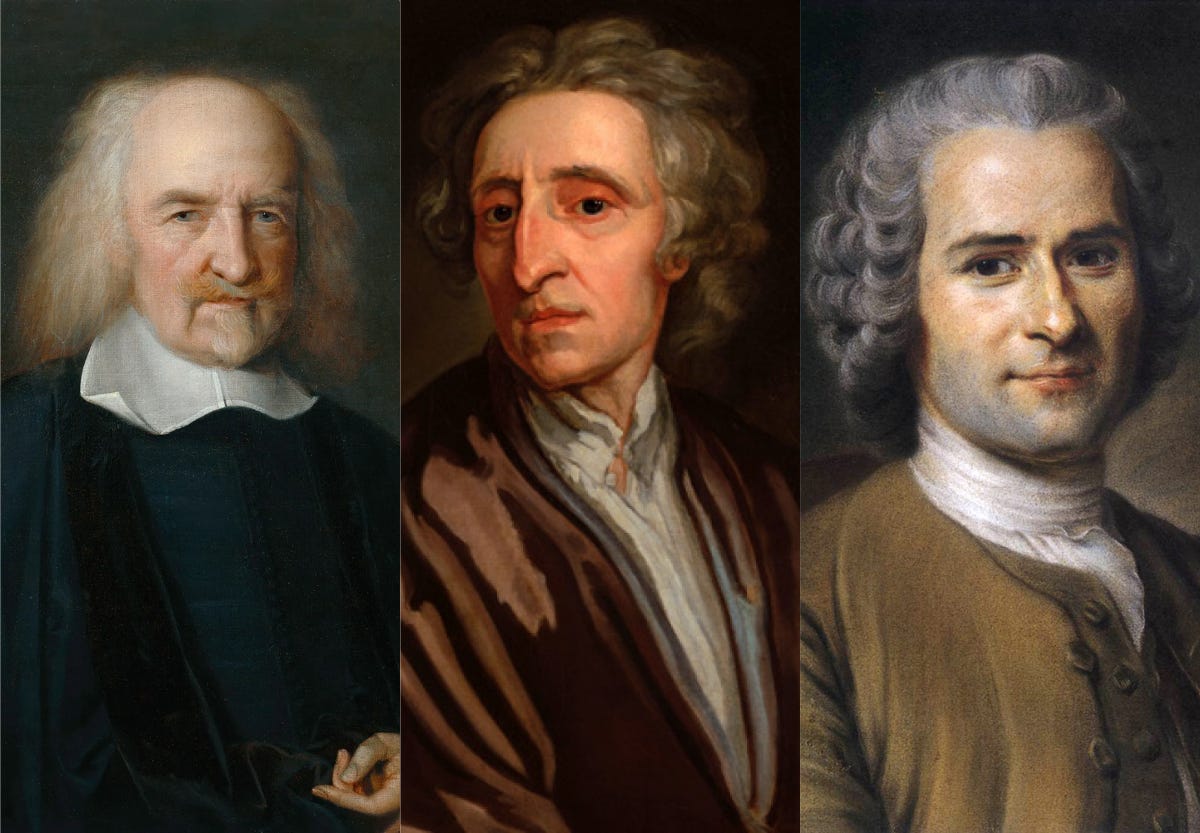
Introduction
The “state of nature” is one of the foundational thought experiments in political philosophy. The move is simple to describe and surprisingly hard to resolve: strip away government, law, police, courts, and every other instrument of political authority, and ask what human life would actually look like. The answer matters because it functions as a justification test. If human beings would do badly without a state, that gives us a reason to accept one. If they would do well, or at least tolerably, the case for political authority weakens, and the case for some alternative grows stronger.
Four positions dominate the tradition, falling along a spectrum from deep pessimism to cautious optimism about human beings left to themselves. Hobbes sees catastrophe and demands an absolute sovereign. Locke sees inconvenience and accepts a limited government by consent. Rousseau sees an innocence that society later corrupts. The anarchists see a problem that can be solved without a state at all. Reading them together reveals that they are not really four answers to four different questions. They are four answers to the same question, and the disagreement turns almost entirely on one variable: how dangerous are people when no one is in charge.
Hobbes: The War of All Against All
Thomas Hobbes gives the darkest account, and it is the one the others spend their careers responding to. For Hobbes, the state of nature is a condition of war, the famous “war of all against all.” His reasoning is mechanical rather than moralistic, which is part of what makes it powerful. He does not assume people are evil. He assumes they are rational, roughly equal in strength and cunning, driven by self-interest, and motivated by a restless pursuit of what he calls felicity, the continual satisfaction of desire. Add scarcity, and the trouble follows logically.
The equality piece is the engine. Because even the weakest person can kill the strongest, whether by stealth, by trickery, or by ganging up, no one is ever safe. That insecurity breeds three drivers of conflict: competition for scarce goods, diffidence (preemptive attack out of fear), and glory (the desire for reputation and recognition). In the absence of a common power to keep everyone in awe, rational self-protection pushes each person toward striking first. The result is a life that Hobbes describes as solitary, poor, nasty, brutish, and short.
Hobbes’s solution flows directly from the diagnosis. If the problem is the absence of a common power, the answer is to create one. Individuals contract with one another to surrender their natural rights to an absolute sovereign, the Leviathan, who holds enough concentrated force to make peace credible. The sovereign’s authority is nearly unlimited because, for Hobbes, anything short of that reintroduces the insecurity he is trying to escape. The price of order is the surrender of self-government, and Hobbes thinks any rational person facing the alternative would pay it.
Locke: Inconvenience, Not Catastrophe
John Locke accepts the basic structure of the argument while rejecting Hobbes’s grim conclusion. For Locke, the state of nature is not war. It is governed by a law of nature, accessible through reason, which teaches that no one ought to harm another in life, health, liberty, or possessions. Crucially, Locke gives every individual the power to enforce this law, which means the state of nature already contains a primitive form of justice. He also softens two of Hobbes’s premises. Where Hobbes assumes scarcity, Locke begins from relative abundance. Where Hobbes assumes pure self-interest, Locke assumes people are often directly motivated to follow the moral law.
This produces a far more livable picture. The Lockean state of nature is peaceful much of the time, and people can acquire property, cooperate, and live decent lives without a sovereign standing over them. But it is not perfect. Locke identifies a set of “inconveniences.” When people enforce the law of nature themselves, they tend to be biased in their own cases, punishments are inconsistent, there is no settled written law everyone can point to, and there is no impartial judge to settle disputes. These defects are not fatal, but they are real, and they make life less secure than it could be.
Because the problem is smaller, Locke’s solution is correspondingly smaller. People do not need to surrender everything to an absolute master. They consent to a limited government whose job is to remedy those specific inconveniences: to provide known law, impartial judges, and reliable enforcement. Authority is a trust held on behalf of the governed and bounded by the purpose it serves, which is the protection of natural rights. If a government betrays that trust, it can legitimately be resisted or dissolved. Where Hobbes’s contract licenses absolute power, Locke’s licenses constitutional and limited power, which is why his fingerprints are all over the American founding.
Rousseau: The Innocence That Society Corrupts
Jean-Jacques Rousseau breaks the pattern in an interesting way. He agrees with Locke that Hobbes was wrong to assume extreme scarcity, but he goes further and denies that morality and moral motivation belong in the state of nature at all. His natural man is not a moral agent following a law of reason. He is a simple, solitary creature guided by two pre-rational drives: self-preservation, and a natural pity or compassion that recoils from the suffering of others. That compassion, not reason and not morality, is what keeps war from breaking out.
Rousseau adds a methodological warning that cuts against both Hobbes and Locke. We cannot infer how “natural man” would behave by observing “civilized man,” because civilization has already reshaped us. The greed, vanity, and aggression that thinkers attribute to human nature may in fact be products of society rather than features of the original condition. This is the heart of Rousseau’s contribution. For him, the state of nature is essentially benign. What corrupts human beings is the emergence of property, comparison, and what he calls amour-propre, the restless need to be esteemed and to rank above others. Inequality and conflict are downstream of social development, not built into us.
This leaves Rousseau in a distinctive spot. He cannot simply recommend returning to nature, because that road is closed once society exists. His answer, developed elsewhere, is to redeem society rather than escape it, binding citizens together under a “general will” so that the freedom lost in leaving the state of nature can be recovered in a legitimate political community. Where Hobbes and Locke ask how to escape the dangers of nature, Rousseau asks how to repair the damage of society.
Anarchism: Do We Need the State at All?
The anarchists pose the sharpest challenge, because they refuse the shared assumption that the state of nature must collapse into a condition the state alone can fix. They are the optimists of the group, and they defend their optimism along three lines.
The first strategy argues that cooperation will evolve even among purely self-interested creatures. People interact repeatedly, depend on one another, and stand to gain more from sustained reciprocity than from one-off aggression, so stable norms of cooperation can emerge without anyone imposing them from above. The second strategy makes a stronger claim about human nature itself: that people are naturally good, and that the violence attributed to the stateless condition is exaggerated or imported from corrupt social arrangements (an argument with a clear Rousseauian flavor).
The third strategy is the most powerful, and the one Wolff treats as most plausible. It concedes that the raw state of nature has genuine defects, exactly the kind Locke worried about, but it argues that political and social structures short of the state can remedy those defects. Custom, voluntary association, mutual aid, reputation, and informal dispute resolution might do the work we usually assign to government, without the concentration of coercive power that defines a state. The interesting consequence is that the gap between “rational anarchism” and a modest defense of the state starts to look very small. Both sides agree we need ordering structures. They differ mainly on whether those structures must take the specific, coercive, monopolistic form we call the state.
The Common Thread and the Open Question
What unites these four positions is more revealing than what divides them. All of them treat the state of nature as a diagnostic device, and the size of the political solution each one recommends scales directly with how dangerous it judges the underlying human material to be. Hobbes sees the greatest danger and demands the largest state. Locke sees moderate danger and accepts a limited one. Rousseau relocates the danger from nature to society and seeks redemption rather than escape. The anarchists see a danger real enough to require ordering, but not so large that only a state can answer it.
The tradition also shares an uncomfortable concession. Locke and Rousseau both grant that the forces they count on to keep the peace, moral motivation, and natural compassion, can only delay serious conflict, not prevent it forever. That admission is what gives the Hobbesian worry its staying power and what the anarchists must overcome. In the long run, the claim goes, nothing genuinely worthy of being called a state of nature is a condition in which human beings can flourish.
Yet whether that observation actually refutes anarchism remains genuinely open. To say that people need ordering rules to flourish is not the same as proving that those rules must come from a sovereign state. The persistent force of the state of nature as a concept is that it keeps that question alive. Every argument for political authority is, at bottom, a bet about what we would do without it, and the four schools simply place different wagers on the same table.