


Introduction
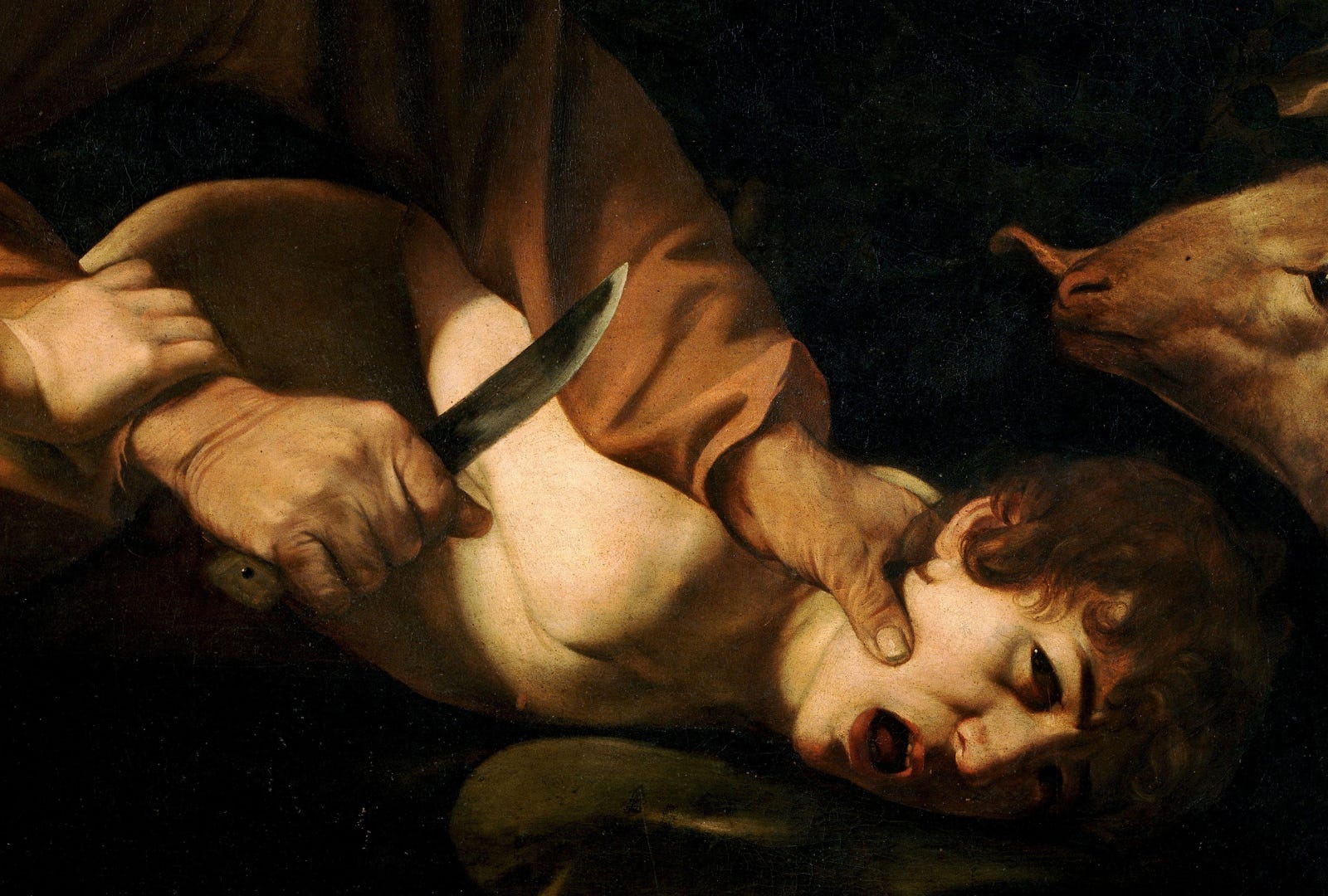
God promised Abraham a future and routed the whole of it through one child. Isaac was born to Sarah when she was ninety years old, long after any reasonable hope had expired, and God named this boy the carrier of the covenant, the line through which the promised descendants would come. Then, in the twenty-second chapter of Genesis, the same God speaks again: Take your son, your only son, whom you love, and offer him as a burnt offering on a mountain I will show you. Abraham rises early the next morning, saddles his donkey, and himself cuts the wood for the offering; three days later, he reaches the land of Moriah with Isaac beside him. The boy carries the wood for his own altar and asks his father the obvious question: the fire and the wood are here, but where is the lamb? God will provide the lamb, his father answers. Abraham builds the altar, arranges the wood, binds his son, and reaches for the knife. Only then does the angel call his name, and a ram stands caught in the thicket. Isaac lives, Abraham descends the mountain, and three religions have called him the father of faith ever since.
Nearly everyone who hears the story hears it as a lesson in trust, and the lesson costs the listener nothing, because the listener knows from the first verse that the ram is coming. Abraham did not. Every step of the three-day walk was taken toward a dead son. Søren Kierkegaard built an entire book on that difference. Fear and Trembling, published in Copenhagen in 1843 under the pen name Johannes de Silentio, is his attempt to make the story dreadful again, and its central claim is easy to state and hard to hold: the faith Abraham had does not belong in the ordinary catalog of virtues; it stands beyond ethics altogether, and the honest response to seeing it clearly is beyond comprehension.
Familiarity Has Sanded the Story Smooth
Kierkegaard wrote from inside a Denmark where Christianity had become a fact of citizenship. A Dane was baptized Lutheran roughly the way he was registered Danish, and faith functioned as furniture: inherited and undemanding. His complaint against that arrangement runs through everything he wrote, and Fear and Trembling is its sharpest early expression. He signed the book Johannes de Silentio, John of Silence, a narrator who confesses on nearly every page that he admires Abraham but cannot understand him; the name is part of the argument, and its meaning arrives later. The title comes from Paul’s letter to the Philippians, which instructs believers to work out their salvation in fear and trembling, two words Danish Christendom had quietly retired.
The book opens with a portrait of a man who had loved the Abraham story since childhood and found that the older he grew, the greater his admiration became and the less he understood. It then retells Genesis 22 four times, each version altered, each darker than the original. In one, Abraham pretends at the last moment to be a monster acting on his own desire, so that Isaac will lose faith in his father rather than in God. In another, the ram is found, and Isaac is spared, and Abraham never again recovers the capacity for joy. The retellings exist to strip the insulation off a story that three thousand years of repetition have made safe. The version told in Sunday school is painless because the ram arrives on schedule. The ram is our comfort, not Abraham’s; he climbed the mountain without it.
Ethically Speaking, Abraham Meant to Murder His Son
Kierkegaard begins where the philosophy of his century stood. In the ethics he inherited, drawn from Kant’s universal moral law and Hegel’s ethical community, morality is the universal: the set of duties that binds every person alike and can be stated to every person alike. A father’s duty within the universal is not obscure; he is to love his son, and the son’s life stands under his protection. Kierkegaard measures Abraham against that standard and refuses to soften the arithmetic. Judged ethically, Abraham set out to murder Isaac; judged religiously, he set out to sacrifice him. Every mitigation a modern reader reaches for fails on the facts: Isaac posed no threat, no famine or enemy forced the choice, no living person stood to gain from the death, and Abraham had three days on the road in which to turn back. If the moral law is the highest court there is, the verdict writes itself, and the father of faith is a murderer interrupted in time.
Kierkegaard’s purpose is not to convict Abraham but to close the exits. Whatever faith is, it cannot be a warmer word for goodness, because here it stands directly opposite goodness. Praise Abraham if we like, Kierkegaard insists, but only after admitting what it is we are praising.
The Tragic Hero Has a Reason; Abraham Has None
The obvious rescue is to file Abraham alongside other fathers whom history asks us to admire through their children’s blood, and Kierkegaard tests exactly that comparison. He sets Abraham beside three of them. Agamemnon sacrifices his daughter Iphigenia at Aulis so the becalmed Greek fleet can sail for Troy. Jephthah, the judge of Israel, keeps the vow that purchased his nation’s victory, at the cost of his daughter’s life. Brutus, consul of Rome, orders the execution of his own sons after they conspire against the law he is sworn to uphold. Kierkegaard calls such men tragic heroes, and his point is that every one of them, however terrible the act, remains fully intelligible. Each surrenders a lower ethical duty, the love of a child, to a higher ethical duty: the nation, the covenant people, the law of the city. The tragic hero never leaves ethics at all; he moves within it, from one obligation to a greater one, and because his reason is public property, his community can weep with him and still call him great.
Abraham has nothing of the kind. His act saves no fleet, upholds no law, and delivers no nation; the death of Isaac would have profited no one alive. Remove God from Agamemnon’s story, and the grim sense of it survives. Remove God from Abraham’s story and what remains is a man with a knife standing over a bound child. Kierkegaard allows no midpoint between the two readings: either Abraham stands somewhere above the tragic hero, in a category ethics cannot reach, or he stands below contempt.
Faith Suspends the Ethical Without Repealing It
The question the book turns on, stated in Kierkegaard’s own vocabulary, is whether there exists a “teleological suspension of the ethical:” whether the moral law, supreme in every ordinary case, can be suspended for the sake of a higher end. The claim of faith, as he reconstructs it, is that it can; that the single individual can stand in an absolute relation to the absolute; that a duty to God exists which outranks the universal itself. On this reading, Abraham is not excused within ethics the way the tragic hero is. He is answerable to something above it.
The word suspension is doing precise work here, because a suspension is not a repeal. The moral law is dethroned as the final authority over Abraham, and yet it loses none of its content and none of its force. Abraham receives no exemption he can feel. The command to love Isaac does not fall silent on the road to Moriah; it presses on him with its entire weight at the same moment as the command to kill him, and both remain fully in effect for all three days. Here the design of the book comes into focus. If the ethical simply switched off for the faithful, Moriah would have been an errand, and Abraham’s obedience would deserve no more notice than a soldier’s. It is because the ethical stays on, undiminished, that the walk requires fear and trembling. A suspension is not an acquittal.
Surrender Isaac, and Expect Him Back
What Abraham does inwardly on that walk Kierkegaard divides into two movements. The first he calls infinite resignation: the total surrender of the beloved thing, grief carried all the way to the bottom, with no reservation held back and no bargain concealed inside the sorrow. A person capable of this movement Johannes names a knight of infinite resignation, and he regards the achievement as rare but human. Agamemnon manages it. So, in principle, can anyone who has ever truly given something up.
The second movement is the one Kierkegaard states openly that he cannot perform. Having surrendered Isaac completely, Abraham simultaneously believes that he will not lose him, that the promise routed through this boy will somehow stand. This is not a calculation. Abraham holds no theory about rams in thickets and no scenario in which the arithmetic works out; the same God has issued the promise and the command, and no reasoning available to him can reconcile the two. Kierkegaard’s formula is that Abraham believes “by virtue of the absurd.” He surrenders everything and expects everything in a single motion, raising the knife in full commitment and full confidence at once. Reason can describe that position from the outside; Kierkegaard’s repeated confession is that no amount of effort lets him occupy it. I can admire Abraham, he says in effect, and I cannot understand him.
Why Abraham Cannot Say a Word
Abraham tells no one. He does not tell Sarah what the journey is for, or the servants who travel with them, or Isaac himself. Kierkegaard devotes the last of the book’s three central questions to this silence, and his answer is that the silence is structural rather than strategic. Justification lives in the universal; a reason is precisely the kind of thing one person can hand to another. Agamemnon can say the words for Greece and be understood by every Greek who hears them. The only sentence available to Abraham, that God has commanded it, is the one sentence the universal is obliged to refuse, since every court and every sane conscience must return the same answer to it. His one recorded reply, that God will provide the lamb, explains nothing and lies about nothing; Kierkegaard reads it as the exact speech of a man whose position cannot be put into speech. Here the pseudonym pays off. The narrator is named John of Silence because the silence is the argument: faith at this height cannot be shared or taught, and a certainty that cannot be shared is also the signature of every fanatic who ever heard a voice. Kierkegaard concedes the point instead of softening it, and the concession produces the book’s final question.
A Fanatic Does Not Tremble
From the outside, Kierkegaard admits, nothing distinguishes the knight of faith from a lunatic. There is no outward mark and no test the rest of us could administer from the safety of the universal; the man on the mountain with the knife looks the same in either case. The difference is interior, and it is absolute. The fanatic has silenced the ethical; the voice that says this is monstrous has been argued down or never spoke, and so he climbs at peace. Abraham silences nothing. He climbs with the full weight of morality on him, loving Isaac entirely, seeing the act exactly as ethics sees it, and obeying anyway. The trembling is not a weakness in his faith; it is the evidence of it.
This is what the word faith contains at full size, and it explains the underestimate most of us begin with. Much of what circulates under the name comfort in grief, confidence about the future, membership in an inherited church, a general trust that things will work out, would not carry anyone three steps up that mountain. Kierkegaard does not ask his reader to imitate Abraham; the whole book denies that the position can be taught, and he never claims to have reached it himself. The demand is smaller and harder: to stop assuming we already possess what Abraham had, and to stop reading his story as though it were safe. On Kierkegaard’s terms, the immense emotional and cognitive weight of this is not a failure to understand the father of faith; it is what understanding him feels like.