


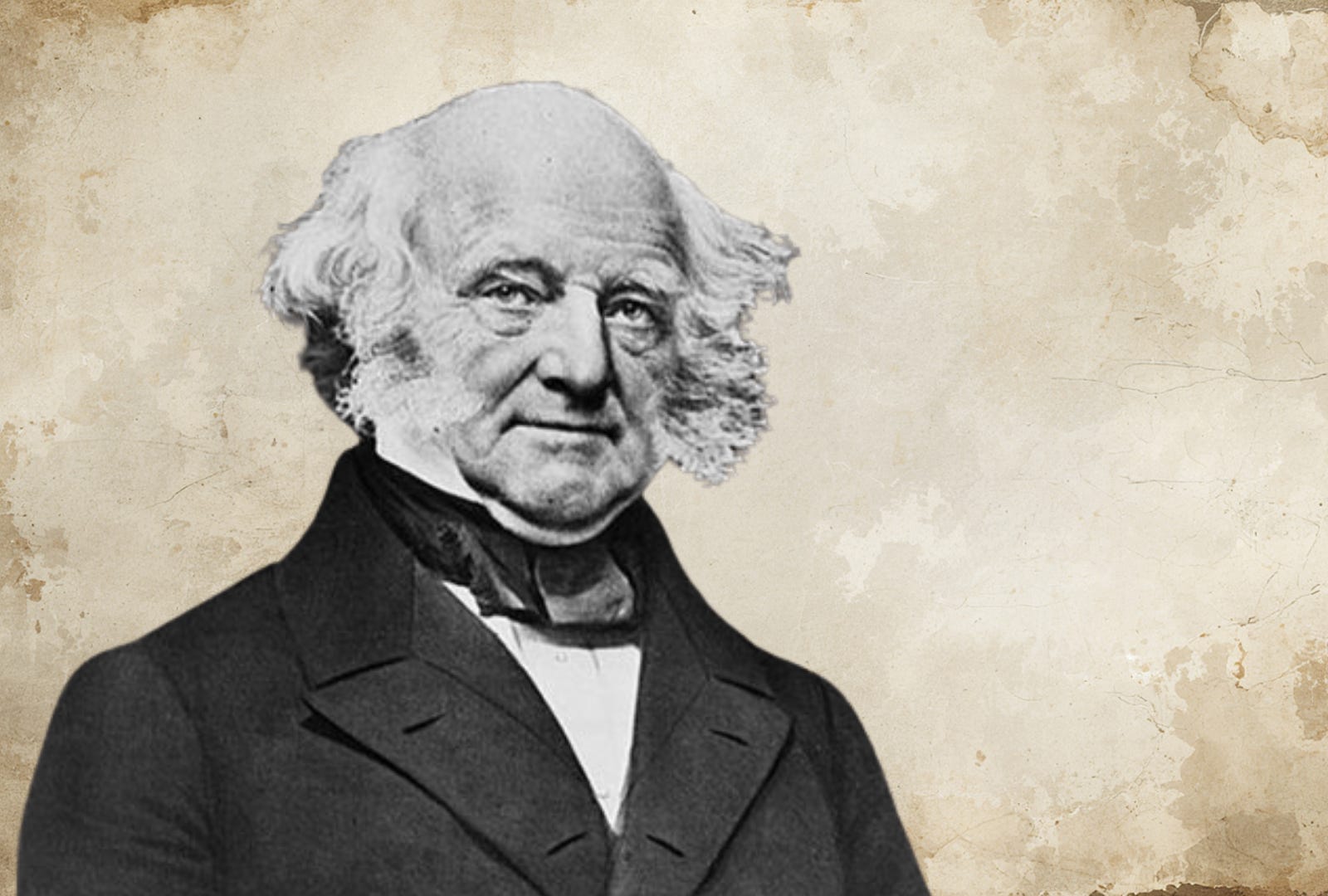
Introduction
In the winter of 1839, Joseph Smith, founder and prophet of the Church of Jesus Christ of Latter-day Saints, traveled to Washington on behalf of some twelve thousand members of his church who had been driven from their homes in Missouri at gunpoint, under a written order from the governor to exterminate them or expel them from the state. Smith carried affidavits itemizing the sworn losses of a ruined people; he carried home a refusal from President Martin Van Buren, which, by one account, said, “Your cause is just, but I can do nothing for you.” That sentence became the founding text of nearly two centuries of bitterness, and the question of what it meant is the subject of this essay.
Mormon history has read the sentence in a single way. The cause was just (the president conceded as much), but he nevertheless turned the Saints away, and the established narrative assumes that no concern ranked higher for him than his own reelection. That reading has passed from generation to generation within the Church despite the thinness of the record beneath it, and for many members, the story still carries a sting.
The difficulty of what follows should be acknowledged plainly, because this is not a case in which the traditional story is simply wrong and a creative revisionist account sets it right. Almost everything the tradition reports about that winter is true: the extermination order, the dead, the stolen farms, the frozen march across the Mississippi, and the refusal in Washington. The bitterness was earned. The error is subtler, and it lives in the space between two questions that feel identical but are not: whether a terrible injustice was done to the Saints, and whether the president possessed the lawful power to undo it. The answer to the first is plainly yes. The answer to the second turns on a body of constitutional law that has changed so completely in the intervening years that a modern reader, looking back, sees a country bearing little resemblance to the one he knows. Judging 1839 by the instincts of the present is the trap of presentism, and the instincts do not fit.
This essay therefore reads the episode four times, each reading laying down a layer that the previous one could not show, in the manner of a press building an image pass by pass. The first pass recounts the traditional narrative as it has been handed down within Mormon history, in all its righteous anger. The second reconstructs antebellum constitutional law and the legal mechanisms in place at that time to address Smith’s concerns. The third examines the evidence itself, the letters and reports written in the moment, with attention to what that record supports and, just as important, what it does not. The fourth applies the facts to the law. Read against the constitutional order of 1839 rather than the instincts of the present, Van Buren’s refusal emerges as an accurate statement of the limits of federal power, and the resentment that Mormon memory has directed at the man for 186 years belongs, if it belongs anywhere, to the constitutional design that bound him.
The First Pass: The Established Narrative
The Saints had come to Missouri believing it was Zion, the gathering place appointed for them, and by 1838, they had come by the thousands. Their numbers frightened their neighbors; old settlers watched a bloc of newcomers arrive with strange scripture and unfamiliar loyalties, voting together, trading together, certain that the land itself had been promised to them by revelation. Fear turned to violence through that summer and fall, in vigilante skirmishes, raids, and burned homesteads that the tradition remembers as a campaign of extermination in the literal sense. On October 27, 1838, Governor Lilburn Boggs made the word official: the Mormons, his order read, “must be treated as enemies, and must be exterminated or driven from the state if necessary for the public peace.” Three days later, at a small milling settlement on Shoal Creek, a militia company rode in and opened fire on families who had been promised protection, killing seventeen, among them ten-year-old Sardius Smith, shot at close range after he was found hiding and begging for his life. The place was called Haun’s Mill, and its name became a synonym for what a state could do to a people it had cast outside the law.
Through that winter, the Saints were expelled, some twelve thousand of them, driven across a frozen Missouri into Illinois while their prophet sat in a cell at Liberty on charges that never came to trial. They had lost farms, livestock, homes, and dead they had no time to bury properly, and they responded as Americans are taught to respond when a state turns against them: they gathered proof. Hundreds of Saints swore out affidavits itemizing every loss, and with those documents in hand they resolved to carry their case over the head of Missouri to the one authority they believed stood above a rogue state, the government of the United States.
That belief is the heart of the traditional narrative. The Constitution, as the Saints understood it, was a covenant, and its guarantees of religious liberty, property, and due process were promises the nation had made to every citizen. Missouri had shattered those promises, and the federal government, as the Constitution’s guardian, would surely make them whole. In the autumn of 1839, Joseph Smith accordingly went to Washington himself, traveling for weeks over bad roads to lay the ruin of his people directly before the President of the United States.
In the tradition’s telling, the president examined the evidence, conceded that the Saints had been grievously wronged, and refused them anyway. “Your cause is just,” Van Buren is thought to have said, “but I can do nothing for you.” Then came the line that hardened over the years into the most remembered and most damning words of the affair: if he helped the Saints, he would lose the state of Missouri in the coming election. A just cause was weighed against a handful of electoral votes, and the votes won. That electoral confession anchors the resentment, and it is also, as the third pass will show, the one element of the story the historical record does not support. The narrative otherwise runs as it always has: Smith left Washington in fury, pronounced Van Buren unfit for his office and less loyal than a dog, and carried the insult home to a people who folded it into their memory and never released it. The government, which they had trusted as the final guardian of their rights, had answered their suffering with a shrug and a calculation.
This is the narrative as it has been handed down, and its anger is not misplaced. A people were nearly destroyed; they came to their government with proof in hand and were turned away. Every element of that account is true, and any history that failed to register its weight would not deserve to be believed. The tradition holds that Van Buren could have helped and chose not to. The passes that follow neither deny the suffering nor soften the refusal; they ask a narrower and more uncomfortable question: whether he could have helped at all.
The Second Pass: The Law of a Different Country
Understanding what happened in Washington requires understanding the Constitution as it existed in 1839, and the first thing to know about that Constitution is that it was not the one Americans live under now. This was antebellum America, a generation before the Civil War and before the succession of amendments, statutes, and Supreme Court decisions that remade the relationship between the states and the federal government from the ground up. Nearly every rule a modern American assumes about that relationship was written after 1839, not before it. It is easier, and more accurate, to treat the Constitution of that year as the governing charter of a different country, one that happened to share our borders and our flag.
That country was not a nation in the modern sense of the word. It was a union of sovereign states, and sovereignty meant something concrete. Each state governed the lives of the people inside it: their property, their contracts, their crimes and punishments, their marriages, their churches, their public order. The federal government was a creature of limited and enumerated powers, competent over war, treaties, coinage, the post, and commerce between the states, and over little else that touched a citizen’s daily life. The ordinary business of protecting a person’s rights was not federal business; it belonged to the states, because that was the bargain the states had struck when they agreed to the Union at all.
This arrangement was not an oversight or a defect awaiting repair. It was the design, and it had logic. The generation that wrote the Constitution feared consolidated power the way a burned child fears fire; its members had just fought a war against a distant central authority, and they built a government deliberately weak at the center, its powers divided and enumerated precisely so that no national officer could reach into a state and govern its internal affairs by decree. To the men of 1789, and to most Americans still in 1839, a federal government that could override a state’s handling of its own citizens was not freedom. It was the very danger the Revolution had fought to escape.
From that first principle, three consequences followed, and they are the three walls that matter for this story.
The first concerns the Bill of Rights, which modern readers find hardest to believe. The first ten amendments are now understood as freedoms belonging to every American against every government; in 1839, they were not. The Bill of Rights restrained only the federal government and said nothing about what a state was bound to obey. A state could establish a church, silence a printing press, seize a home without compensation, or deny a man any semblance of fair process, and the First, Fifth, and Sixth Amendments had nothing to say about it, because they had never been addressed to the states at all. Nor was this one interpretation among several: the Supreme Court had settled the question directly in 1833, in Barron v. Baltimore, where Chief Justice John Marshall held for a unanimous Court that the Bill of Rights limited the national government and the national government alone. A citizen wronged by his own state looked to his state’s constitution for protection, and to nothing above it.
The second wall was jurisdictional. One imagines that a citizen with a federal constitutional grievance could at least file suit in a federal court and be heard; in 1839, he generally could not. Congress had never granted the lower federal courts broad power to hear cases simply because they arose under the Constitution, and that grant, now taken for granted, did not come until the Judiciary Act of 1875. Before then, the federal courts were open only in specific and limited circumstances, and a citizen claiming that a state had trampled his rights usually had no federal courtroom available to him at all. There was likewise no federal statute allowing a person to sue an official who had violated his rights under color of state law; that tool, the ancestor of nearly every modern civil rights suit, would not be created until the Civil Rights Act of 1871 (also known as the Ku Klux Klan Act and surviving today as 42 U.S.C. § 1983). The machinery a modern claimant would reach for instinctively had not been built.
The third wall enclosed the presidency itself, and it rested on a principle so basic it is easily overlooked: under the Constitution, the president cannot spend money. The power of the purse belongs to Congress alone, exclusively and jealously, and a president moved by the most righteous cause in the world cannot pay a dollar from the Treasury to remedy it unless Congress has appropriated the funds. The Constitution does give the president a voice; he may recommend measures to Congress for its consideration. But a recommendation is not a remedy. It is a request directed at the one branch holding the money and the lawmaking power, and that branch remains free to do exactly nothing with it.
One provision, finally, seemed written for precisely the kind of catastrophe this essay examines. The Constitution promises that the United States shall protect each state against domestic violence, and on its face, the clause sounds like a federal guarantee of rescue when order collapses inside a state. But the clause carries its own decisive lock: federal protection may be extended only on the application of the state’s own legislature or governor. The state must ask. Washington cannot force its protection upon a state that has not requested it, and it certainly cannot deploy the clause against a state government that is itself the source of the violence. The provision was designed to help a state that wanted help, not to discipline one that did not.
Taken together, these pieces describe a federal government that was, by deliberate constitutional design, nearly powerless to intervene between a state and the people inside it. The Bill of Rights did not bind the states; the federal courts were largely closed to constitutional claims against them; the president could neither spend nor command his way to a remedy; and the one clause promising federal protection could be triggered only by the offending state itself. This was not a gap in the law. It was the architecture of the law, faithfully reflecting a country that trusted states, feared central power, and had written both instincts into its highest charter.
All of that would change, but not for a generation, and not without a war. Only the carnage of the Civil War forced the nation to rebuild its charter, and the rebuilding came in a burst of constitutional enactments between 1865 and 1875 that a modern American would recognize as the beginning of the country he now inhabits. The Fourteenth Amendment, ratified in 1868, made national citizenship supreme, forbade any state to deny life, liberty, or property without due process, and armed Congress to enforce those guarantees. Alongside it came the machinery to make the promise real: the Civil Rights Act of 1871, which for the first time allowed a citizen to sue an official who violated his rights under color of state law, and the Judiciary Act of 1875, which finally opened the federal courthouse doors to any case arising under the Constitution. Even then, the transformation was slow, and the courts spent the better part of the next century deciding, case by case, how much of the Bill of Rights the Fourteenth Amendment actually applied against the states. But the direction was set, and the country that emerged from those years is the country whose instincts we now carry. It did not exist in 1839. In 1839, the older design still stood, every wall intact, and any question of what the federal government could do for a persecuted people had to be answered within it.
The Third Pass: What the Historical Record Actually Says
Everything to this point has been context. The first pass supplied grievance as it has been remembered, and the second supplied the legal world that grievance was born into. The third pass changes the picture, not by argument but by evidence, by setting the surviving documents side by side and reading them in the order they were written.
On December 5, 1839, six days after they were received at the White House, Joseph Smith and Elias Higbee wrote a letter to Hyrum Smith and the high council back in the Church, describing the encounter while it was fresh. The letter is the closest thing history possesses to a transcript, written by two of the men who were in the room, addressed to their own people, with no reason to flatter the president and every reason to record his failures. They were not kind to him: they mocked his appearance, called him a fop, and complained that they could find no way to make him understand their cause. The contempt is already present on the page, six days after the meeting.
The content of their report matters more than its tone. By their own account, Van Buren looked at them “with a kind of half frown” and said, “What can I do? I can do nothing for you; if I do anything, I shall come in contact with the whole State of Missouri.” That is the contemporary record of the refusal, and what it omits is as significant as what it contains. There is no “your cause is just.” There is no confession about losing the vote of Missouri, and no mention of the election at all. The reason the president gives, in the earliest and best account available, is that acting would bring the federal government into collision with the State of Missouri. That is not the language of a politician counting votes; it is, almost word for word, the language of the constitutional problem described in the second pass, under which the federal government could not set itself against a sovereign state in the handling of that state’s own affairs.
The same letter records two further details that the established narrative tends to forget. It reports that the delegation “demanded a hearing and constitutional rights,” and that the president, far from dismissing them, promised to reconsider the matter and expressed sympathy for their suffering. Whatever happened in that parlor, the men who were present and who despised the man recorded a president who gave a jurisdictional reason and agreed to think again.
The provenance of the famous line is a different matter. “Gentlemen, your cause is just, but I can do nothing for you,” paired with the damning admission about the vote of Missouri, does not appear in the contemporary letter. It appears in Joseph Smith’s history under the date of February 6, 1840, more than two months later, attached to what is described as a second meeting with the president, and at this point the record grows genuinely uncertain in a way that matters. Historians who have worked closely with these documents cannot establish that a second meeting took place at all; the editor of the definitive edition of the Saints’ redress petitions writes only that it is “possible” that Smith had a second interview with Van Buren, resting on that February entry alone. The account survives in the History of the Church, a work compiled and refined over many years, published well after the events it records, and assembled from journals, memories, and reconstructions by clerks and later hands. The damning quotation, in other words, belongs to the later, compiled, and uncertain stratum of the record rather than to the letter written in the moment.
The distance between the two accounts carries the analytical weight. The early account, written days after the event by two hostile witnesses standing in the room, gives a constitutional reason and no politics; the later account, entered months afterward and preserved in a history assembled over the following years, gives the electoral confession that has anchored the grudge ever since. When a source compiled later contradicts a source written in the moment by the same aggrieved party, the historian’s rule is not subtle about which to trust. The nearer witness prevails, and the nearer witness heard a president speak about Missouri, not about votes.
The other half of the record is simply absent. Van Buren left no account of the meeting: no letter, no diary entry, no memorandum in his papers, and no mention of Joseph Smith or the Mormon delegation anywhere in the material he left behind. The absence proves nothing by itself, and the temptation to make too much of it should be resisted, but it does invite a restrained speculation. To the Saints, this was among the most consequential encounters of their lives, the moment their nation would either honor its promises or betray them; to Van Buren, it may have been nothing of the kind, one more petitioner turned away on grounds so settled they required no explanation, an answer as routine to him as it was devastating to them. That asymmetry of significance would itself explain the silence, and if the reading is right, it suggests that the refusal remembered as the great betrayal of Mormon history registered on the other side of the desk as the unremarkable application of ordinary law. Whatever the explanation, the silence has one undeniable consequence: there is no independent check on the Mormon accounts, no neutral witness, and no second source standing outside the aggrieved party. Every word attributed to the president comes from the men he turned away, and when the only witnesses are the wounded, the historian must ask which of their memories was written closest to the wound, and trust that one most.
None of this means the Saints lied. Honest memory reshapes what it holds; it compresses two encounters into one, sharpens a vague refusal into a quotable line, and supplies a motive that fits the pain. But it does mean that the record, weighed as a historian must, points in a particular direction. The evidence written closest to the event supports a president giving a constitutional reason. The evidence for a president confessing electoral cowardice is later, uncertain, uncorroborated, and preserved in a history assembled well after the fact, through the very processes of memory and retelling that turn history into legend.
One further document may be the most telling of all because it comes not from Van Buren’s defenders but from Joseph Smith. Five years after Washington, in 1844, Smith ran for President of the United States and published a platform; among its planks was a proposal to give the president the power to send troops to suppress mob violence in a state without waiting for the governor to request them. Read against the second pass, the meaning of that plank is unmistakable. The Article IV lock, the rule that federal protection could come only on the state’s own application, was the very wall the Saints had struck in Missouri, where the governor was the persecutor and would never request help against himself, and Smith’s platform proposed to tear that wall down. He was campaigning, in other words, to create the exact federal power that had not existed in 1839, and a man does not propose to build a mechanism he believes already exists. The most sophisticated constitutional critic of the Missouri refusal turns out to be Joseph Smith, and his own proposed remedy amounts to a quiet concession that the power to help had never been there.
None of this lessens the suffering, and none of it is meant to. The affidavits were real, the losses were real, and the refusal was real. What the record revises is not the wrong done to the Saints but the story they told about the man who turned them away: laid out in order, document by document, the evidence does not show a president who admitted a just cause and chose votes over justice. It shows a president who gave a constitutional reason for an answer the Constitution had already written, and a people who, in their grief, remembered it as something crueler.
One anomaly in the record deserves attention before the final pass, because the electoral theory cannot survive it unexamined. If Van Buren refused the Saints because helping them would cost him Missouri’s votes in the election of 1840, the subsequent history requires explanation. The Saints did not give up; they carried the same plea back to Washington after Van Buren left office and laid it before a government controlled by his Whig opponents, men with every partisan incentive to embarrass a fallen Democrat by granting what he had denied, and they were refused again. An obstacle consisting of one anxious politician guarding his reelection should have vanished with the politician. It did not, and the final pass shows why.
The Fourth Pass: What Actually Happened
The image is now complete enough to finish. The first three passes supplied the grievance, the law, and the record; what remains is the exercise the tradition never performed, which is to take the Saints’ actual plea, carry it to each door the second pass identified, and determine whether a single one could open. The stakes of that exercise are exact. If even one door stood open, Van Buren’s refusal was a choice, and the resentment is earned; if every door was locked before he spoke, the man was not the obstacle, and 186 years of resentment have rested on a mistake about how the government of 1839 worked.
The constitutional door failed first. The Saints came claiming that Missouri had violated their rights to worship, to hold property, and to receive due process, rights they believed the federal Constitution guaranteed them. But Barron v. Baltimore had settled the question six years earlier: the Bill of Rights did not bind the states, and Missouri was not answerable to the First Amendment, the Fifth, or any of them. The very foundation of the Saints’ claim, that a state had broken federal constitutional promises, described a wrong that federal constitutional law did not yet recognize. The door marked constitutional rights was not merely closed; in 1839, it opened into an empty room.
The judicial door was equally shut. A modern lawyer’s first instinct is to find a federal court and file, but no federal courthouse was open to the Saints: Congress had granted the lower federal courts no general power to hear claims arising under the Constitution, and would not until 1875, and no statute permitted suit against the officials who had wronged them, and none would until 1871. The Saints could not sue Boggs, could not sue Missouri, and could not bring their constitutional grievance into any federal court in the country, because the courts with the power to hear it did not yet exist. That door was locked, and the key would not be cut for three more decades.
The executive remedies fare no better, though the tradition feels strongest here, on the instinct that a president can always do something. The two locks identified in the second pass dispose of the instinct. Federal protection against domestic violence could be extended only on the application of the state itself, and in Missouri, the state was the persecutor; Boggs would no more request federal intervention against his own extermination order than a man would summon the police to arrest himself. And the president could not open the Treasury, because he could not spend a dollar Congress had not appropriated. Every forceful remedy the imagination supplies, troops or money or federal muscle of any kind, ran into a wall the Constitution had built around the office itself. The president could not command his way to a remedy, nor could he buy his way to one.
One door genuinely was open, and honesty requires walking all the way up to it. The president could have spoken. He could have used his one lawful instrument, the power to recommend measures to Congress, and placed the moral weight of his office behind the Saints’ memorial. He did not; his annual message that December said nothing of Missouri, and the delegation, which had waited for it, went home empty. This is the true charge against Martin Van Buren, and it should be stated without flinching: he had one thing he could lawfully do, and he chose not to do it.
But the open door does not lead where the tradition assumes, and the anomaly identified at the close of the third pass resolves here. A presidential recommendation is not a remedy; it is a request to Congress, the branch that alone could have appropriated compensation or fashioned relief, and Congress’s answer is not a matter of speculation, because Congress answered. The Saints’ memorial went to the Senate, which referred it to the Judiciary Committee, which studied the claim and reported that the wrongs alleged were Missouri’s to redress rather than the federal government’s, and that the case lay beyond congressional power to reach. The petition was tabled. When the Saints returned and petitioned again, in 1840 and once more in 1842, the result never changed, though by then Van Buren was gone, and his Whig rivals held the government he had left. His enemies, with the election behind them and every incentive to shame a fallen Democrat by granting what he had denied, gave the Saints the same refusal he had. Different men and a different party produced the same answer, because the answer was never about the men; even the one open door, had Van Buren walked through it, led only into a room where the same constitutional wall stood waiting.
Set the Saints’ plea against every remedy the age afforded, then, and each fails in turn, not for want of courage or compassion but for want of law. The rights they invoked did not yet bind the states; the courts that could have heard them did not yet exist; the force they needed the president could not command, and the money he could not spend. The one thing he could have done would have changed nothing, and the record proves it did, because Congress twice refused what a recommendation could only have requested. When Van Buren said he could do nothing, he was not describing the size of his heart. He was describing the size of his office, and he described it correctly.
The finished image is a hard one to hold. The established narrative needs Van Buren to be a coward because a coward can be blamed, and blame gives suffering a human face and a moral shape. The history is colder: the Saints were destroyed by a lawful order, denied by a lawful refusal, and turned away by a government deliberately built without the power to save them. Their cause was just, and the remedy did not exist, and both were true at once. The sentence held against Martin Van Buren for 186 years was, in the end, the most honest answer anyone in Washington could have given.
Conclusion: What We Owe the Dead, and the Living
A story that fails on the evidence demands precision about which part fails, because here the failure is narrow. The suffering is not in question: the extermination order stands, Haun’s Mill stands, and the frozen exodus, the plundered farms, and the hurried graves stand, and always will. What does not stand is the villain. The claim that Van Buren looked upon a just cause and traded it for the electoral votes of Missouri rests on a sentence that appears nowhere in the contemporary record, surfaces only in a later account within a history compiled well after the meeting and sits uneasily beside the words the delegation wrote down while the encounter was still warm.
The scale of the correction should also be stated honestly. Van Buren is not a major figure in the Latter-day Saint story; he appears for a moment, delivers his refusal, and exits, and a reader is entitled to ask why a single misremembered sentence, spoken by a minor character in one bad winter, merits this much attention. The answer is that the error is small but not nothing, and that small, durable errors are often the most revealing kind. This one has lasted 186 years, taught and repeated without examination, and it survived not because anyone weighed the evidence and found it strong but because no one needed to. Van Buren himself matters little; how a story like his survives reveals how all inherited stories survive.
The story did more than survive in the retellings; it hardened into ritual. In 1877, at the St. George Temple, Wilford Woodruff directed proxy ordinance work for the deceased presidents of the United States, nearly the entire line of them, and passed over exactly two. One was James Buchanan, who had sent an army against the Saints in Utah. The other was Martin Van Buren, omitted, in the words of the surviving record, because of his unwillingness to address the wrongs done to the Saints in Missouri. A prophet surveying the whole sweep of American history reached back nearly forty years to single out one president by name and exclude him from a sacred rite, on the precise ground that he had chosen not to help, which is to say, on the strength of the very accusation the contemporary record does not support. The grudge was no longer merely remembered; it had become something the Church did.
The sequel is the quietest argument in this essay’s favor. The exclusion did not hold: Van Buren had, in fact, already been baptized by proxy the year before Woodruff passed him over, and in 1938, the rest of his temple work was completed. Whatever the resentment of 1877 intended, the tradition’s deeper instinct, the one that reaches toward every soul rather than sorting them into the worthy and the condemned, eventually gathered even him in. The faith corrected the indignation before any historian thought to do so.
The resentment endured as long as it did because it asked so little of anyone. A story of persecution goes down easier with a persecutor in it, and a president who shrugged is a simpler thing to hold than a constitution that was never built to help; blame gives a formless catastrophe a face, and a face can be named, and something named can at last be set down. There is a kind of mercy in that arrangement, and it deserves acknowledgment before anyone is asked to surrender it. But the man who has served as that face, called a coward in the retellings, his name a quiet byword for betrayal, earned the role mostly by standing in the room when the answer came. His real offense was to describe his office accurately.
A question remains that a believing reader is better equipped to weigh than any historian. A tradition that teaches the love of enemies and returns again and again to forgiveness as the harder and higher obligation has carried this one resentment a long way, on evidence it could not produce if asked. The observation is not an accusation; it is offered because the tradition already contains its own correction, more persuasively than scholarship could supply it. The proxy work completed in 1938 is that correction, quietly performed. Nothing in the faith requires that this man be remembered with contempt, and the persecution narrative, which never needed him, loses none of its power when he is at last released from it.
Releasing him costs the tradition nothing it should wish to keep, and it returns something larger than it surrenders. The Missouri Saints were among the first Americans to learn, in their own property and their own bodies, that the Constitution of 1789 contained a hole precisely where a persecuted minority most needed cover. They were not wrong that the nation had failed them; they were wrong only about whom inside the nation to blame. The failure was not one anxious man in a parlor. It was structural, written into the design, the same hole that left the enslaved without recourse and that would not be closed until a war and an amendment closed it. Seen this way, the Saints’ suffering stops being a private grievance and becomes a public warning, a chapter in the long American argument over whether the rights of the few are the concern of the whole, and every citizen who has since been shielded from his own state by the Fourteenth Amendment is, in some measure, an heir to what the Saints endured when no such shield existed.
That is the story worth keeping, and it is a better one than the grudge. The martyrs remain martyrs; the exodus remains an epic; and the courage of the Missouri Saints only grows once the fantasy that one sympathetic signature could have lifted their tragedy is abandoned, and the full machinery of a country that left an entire people without recourse comes into view. The grievance shrinks that story to the size of a villain. The truth restores it to the size of a nation, and the release of the tradition’s own temples, begun quietly decades ago, is one its history can now afford to finish.