


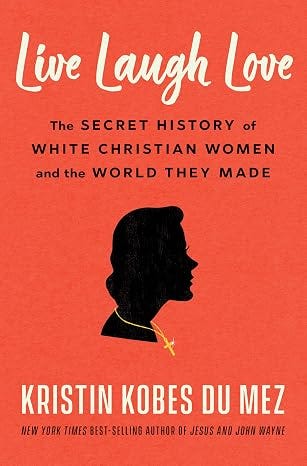
Du Mez, Kristin Kobes. Live Laugh Love: The Secret History of White Christian Women and the World. Liveright, 2026. 432 pages. Hardcover. ISBN: 9781324090977.
The “Live Laugh Love” sign hanging in millions of American kitchens looks like the least political object in the country, and Kristin Kobes Du Mez argues that it very much is. Most histories of the religious right study preachers, politicians, and pulpits. Du Mez studies what evangelical women bought, read, and sold, and finds a second Christianity there, built by women who were barred from leading the first. Shut out of pulpits and seminaries, white Christian women built their faith from devotional bestsellers, Christian radio, Hallmark movies, home-based sales businesses, and the pastel aisles of Hobby Lobby. That faith had little formal theology but enormous reach, and its message held steady for over a century: a cheerful attitude and a well-kept home bring God’s blessing, and a woman’s calling is to submit and smile. Du Mez traces that message from nineteenth-century revivals to the 2024 election and argues that it did political work. It taught millions of women that the home was theirs to defend, and it made Christian nationalism feel like common sense. Her previous book, Jesus and John Wayne, linked evangelical masculinity to Donald Trump’s rise. Live Laugh Love argues that women didn’t just watch that movement grow; they helped build it, one throw pillow at a time.
Du Mez is a historian of American religion and gender with a doctorate from Notre Dame. Her first book, A New Gospel for Women (2015), recovered the story of Katharine Bushnell, a Victorian doctor and missionary who reinterpreted what the Bible teaches about women. Jesus and John Wayne (2020), a history of militant evangelical masculinity, made her a public figure; it reached the New York Times bestseller list and drew a wave of rebuttals. Live Laugh Love is the second half of that project. It has the same strengths, deep research and a sharp eye for the telling object, and the same tendency to turn a pattern into an indictment. Du Mez writes from within the Reformed Christian tradition she studies, giving her an insider’s ease with the material and, at times, an insider’s impatience.
The first part, covering the 1800s through the 1950s, introduces the promise that runs throughout the book: a woman who surrenders to God and keeps a cheerful spirit will be rewarded with happiness. It begins with Hannah Whitall Smith, a Philadelphia Quaker whose 1875 bestseller, The Christian’s Secret of a Happy Life (1875), made that promise famous. For women, Du Mez notes, surrender came to mean sweetness and subordination. Smith is the book’s best portrait. Her letters reveal a marriage to a scandal-prone preacher and a faith far less tidy than the one her readers bought. Du Mez then shows how Smith’s message merged with New Thought, a popular movement that taught that positive thinking brings health and wealth. Women could not preach that blended gospel from the pulpit, but they could teach it. Henrietta Mears, a Hollywood Sunday school teacher, best exemplifies this New Thought movement. She never led a church, yet her students founded Young Life and Campus Crusade for Christ, and she urged a young Billy Graham toward mass evangelism. Through them, her mix of personal faith and free enterprise spread far beyond her classroom.
The second part, the 1950s through the 2000s, follows the message through three channels: marriage manuals, home-sales businesses, and, finally, politics. The manuals came first. Helen Andelin’s Fascinating Womanhood (1963), written by a Mormon homemaker, and Marabel Morgan’s The Total Woman (1973), which taught wives how to greet their husbands at the door, taught that submission was a form of seduction. Du Mez finds that later manuals copied each other almost word for word, even claiming that a wife who refused her husband was guilty of the sin of selfishness. Next, the same message became a business model. Mary Kay Ash, Mary Crowley of Home Interiors and Gifts, and Amway founders Rich DeVos and Jay Van Andel recruited Christian housewives as door-to-door and party-plan sellers, promising that a cheerful attitude would be rewarded in this life. Finally, Phyllis Schlafly and Anita Bryant turned those same women into a political force against the Equal Rights Amendment and gay rights. Du Mez makes a persuasive case that the politics grew out of the culture. The women who defeated the ERA had spent a decade reading books and attending sales meetings that told them the home was their domain and defending it was their calling.
The book then turns to popular culture, which carried the same ideal to women who never opened a marriage manual. The television series Little House on the Prairie made the Ingalls family a model of cheerful, God-fearing homemaking, and Janette Oke’s Love Comes Softly (1979) launched a genre of Christian romance novels built on the same picture of womanhood. Hobby Lobby, whose owners took their fight against covering contraception to the Supreme Court in 2014, sold the decor that went with it. Du Mez then shows what that ideal could cost. Elisabeth Elliot, a missionary widow whose Through Gates of Splendor (1957) made her a heroine of Christian surrender, later married an abusive husband. Du Mez argues that Elliot’s silence about the abuse followed from the submission she had taught all her life, and it makes for the book’s most unsettling chapter. Purity culture closes the section. Du Mez quotes youth pastors who told girls that sex before marriage would leave them like chewed gum that no one wants, a comparison meant to shame them into abstinence
The final part carries the story from the mommy-blog era to the end of 2025, as the message moved online and the women who carried it began to split. Some turned the message into a personal brand. Rachel Hollis’s bestseller Girl, Wash Your Face (2018) promised that the right attitude could fix almost anything, which Du Mez reads as New Thought for the Instagram age. Others broke away. Beth Moore, whose Bible studies had made her the most influential woman in the Southern Baptist Convention, left the denomination in 2021 after publicly criticizing its leaders, though the book gives her only a few pages. Today’s tradwife influencers, who film themselves baking bread and raising large families, bring the story to the present. Erika Kirk, whose words at her husband’s televised memorial open the book, stands for where this culture has arrived. Du Mez ends by borrowing a line from the late writer Rachel Held Evans, who named patriarchy, white supremacy, and violent religious nationalism as the trinity this culture came to serve. The last fifty pages feel rushed, however, and the book loses energy as it nears the present.
The book’s strength is the connections it draws. No one before has traced a line from Smith’s happy-life theology through Mears’s Sunday school, Mary Kay’s pink Cadillacs, and Oke’s prairie romances to the home-goods aisle, and that line holds for most of the book. The notes run nearly fifty pages, and the chapters on Smith, Mears, and Elliot could stand alone as essays. The weaknesses come from the method. Du Mez relies heavily on bestsellers, but a bestseller shows a book sold well, not how readers received it. The first part also spends a surprising amount of space on men, such as Dwight Moody, Peale, and Oral Roberts, before the women arrive. The bigger problem is proportion. The evidence shows that a consumer culture of positive thinking shaped white evangelical womanhood. It does not show that this culture produced the politics of the last decade, and the closing chapters assert that link more often than they prove it. Du Mez gives her critics little hearing, and her own politics surface late in a way that may lose readers she could have kept. Evangelical critics have also challenged her reading of the Elliot biography, a dispute worth checking before accepting her account of Elliot’s final years. The writing is clear and quick, and occasionally wry.
Two earlier books make useful companions. R. Marie Griffith’s God’s Daughters (1997), based on years spent with a national women’s prayer fellowship, argued that submission could be a real source of strength and community for the women who chose it. It offers the sympathy Du Mez often withholds. Barbara Ehrenreich’s Bright-Sided (2009) traced the same positive-thinking gospel through American business and self-help, with no churches in sight. Du Mez shows what happened when that gospel moved into the pew and the living room. Readers who want a sympathetic account of why these women believe what they believe should start with Griffith. Readers who want to know how a slogan on a throw pillow connects to a political movement should start here. The book is stronger as history than as argument, and its final section overreaches. But its first three hundred pages are the most engaging account yet of a religious culture that theologians ignored and merchants built. For anyone who grew up inside that culture, or who is trying to understand someone who did, Live Laugh Love is essential reading.
ABOUT THE REVIEWER: Bryan D. Eisenbise of Orange County, California, earned his B.A. in Business Management from California State University, Fullerton (2002); his M.B.A. and J.D. from Texas Tech University (2004); and his LL.M. from Chapman University School of Law (2008). He is currently pursuing an M.A. in History at California State University, Fullerton. His research interests include American Legal History, Political Philosophy, and Mormon History.