


Introduction
The American constitutional order that emerged from the Philadelphia Convention in 1787 was built on a foundational paradox. The Declaration of Independence had announced eleven years earlier that “all men are created equal,” but the Constitution that followed contained no such guarantee. On the contrary, it produced a framework that gave inequality the force of constitutional law through the Three-Fifths Clause, the Slave Trade Clause, and the Fugitive Slave Clause: a structural misalignment between the nation’s professed values and its legal architecture that would shape American constitutionalism for decades to come and set the stage for civil war 74 years later.
Between the rise of Andrew Jackson in 1828 and the close of Reconstruction a half-century later, that misalignment was tested, exploited, and ultimately confronted in ways the founding generation could not have anticipated. The Jacksonian era expanded democratic participation for white men through the elimination of property qualifications while simultaneously stripping voting rights from free Black Americans and authorizing the forced removal of southeastern tribes from their ancestral lands. President Jackson openly defied the Supreme Court’s ruling in Worcester v. Georgia, and his successors presided over the Trail of Tears. The antebellum decades that followed saw the Constitution weaponized to entrench slavery and override state protections for free Black Americans, culminating in Prigg v. Pennsylvania, the Fugitive Slave Act of 1850, and ultimately Dred Scott v. Sandford, which denied that any person of African descent could ever be a citizen of the United States.
By the eve of the Civil War, no constitutional mechanism remained capable of resolving these contradictions, and complete rupture became the only path forward. The war shattered the consensus that had sustained the antebellum order, forcing the nation to confront whether a government founded on liberty could endure while denying it to millions of its own citizens. Reconstruction then attempted, for the first time in American history, to write the Declaration’s promise of equality directly into the constitutional text through the Thirteenth, Fourteenth, and Fifteenth Amendments. This essay argues that the period between Jackson and Reconstruction did more than expose a persistent misalignment between American values and American law; it set the nation on a collision course with itself, one that could only be resolved through civil war and the constitutional transformation that followed.
Jackson’s Legacy: Democracy for Some, Dispossession for Others
The Jacksonian era expanded democratic participation while weaponizing the legal system against subordinated groups. Between 1828 and 1840, most states eliminated property qualifications for white male suffrage, recasting it from a privilege tied to landownership into a right of citizenship. But the same legislatures that opened the polls to propertyless white men concurrently inserted racial qualifications that stripped voting rights from free Black men who had previously been able to vote. The result was a democratic expansion measured exclusively in white terms, with the rhetoric of equal rights running directly alongside the systematic legal degradation of Black Americans. The Constitution did not require this outcome, but it did not prevent it either, and that absence of constraint created a legal order that left the question of who counted as a rights-bearing person almost entirely to the political process.
Andrew Jackson himself operationalized tension. In 1832, Congress passed a bill to recharter the Second Bank of the United States and Jackson vetoed it. His veto message went beyond the ordinary grounds of policy disagreement: he declared the Bank unconstitutional despite the Supreme Court’s earlier ruling to the contrary in McCulloch v. Maryland (1819) and claimed that the President possessed an authority to interpret the Constitution equal to that of the Court. The executive, in Jackson’s view, was not bound to defer to the Court on questions of constitutional meaning. Jackson’s same theory of executive supremacy was later used to justify his refusal to enforce a Supreme Court ruling. But ironically, Jackson claimed that his actions embodied constitutional principles, yet this view later became the mechanism by which the Marshall Court’s most important Indian law ruling became unenforceable.
Cherokee Nation v. Georgia (1831) became the constitutional test. Gold was discovered on Cherokee land in Georgia in 1828, and the state responded with a sweeping legislative campaign to extinguish Cherokee sovereignty, extending state law over Cherokee territory and surveying Cherokee land for distribution to white Georgians by lottery. In the Supreme Court case that followed, Chief Justice John Marshall dismissed the Cherokee bid for original jurisdiction by holding that tribes were not “foreign States” under Article III but “domestic dependent nations” whose relationship to the United States resembled “that of a ward to his guardian.” The phrase did real doctrinal work, recognizing tribes as distinct political communities while denying them the procedural vehicle they needed, and Marshall’s reasoning hinted that the substantive question of sovereignty might yet be vindicated on a proper jurisdictional posture.
That posture arrived the following year. Samuel Worcester, a white missionary convicted under a Georgia statute requiring white residents of Cherokee territory to obtain a state license and swear allegiance to Georgia, brought the substantive question forward on a writ of error. Marshall’s opinion in Worcester v. Georgia (1832) was the doctrinal high-water mark of tribal sovereignty: “The Cherokee nation, then, is a distinct community, occupying its own territory, with boundaries accurately described in which the laws of Georgia can have no force.” Marshall held the Georgia statutes void as repugnant to federal treaties and the Supremacy Clause, ruled that federal authority over Indian affairs was exclusive of state authority, and ordered Worcester released. The Marshall court answered the constitutional question: Cherokee sovereignty was real, Georgia’s encroachment was unconstitutional, and the federal government had the obligation to protect it.
What followed was the foundational example of constitutional dismissal by political will. Jackson reportedly responded, “John Marshall has made his decision; now let him enforce it,” and whether he said exactly those words, the substantive position was his. The federal executive made no effort to enforce Worcester against Georgia, Georgia ignored the ruling, and the Cherokee Nation was forcibly removed in 1838 on the march that killed approximately four thousand of them. The Constitution, as authoritatively interpreted by the highest court in the country, said one thing; the political branches did the opposite. The Jacksonian misalignment is therefore not a story about ambiguous constitutional text or contested doctrine. It is a story about a constitutional system in which the Supreme Court could declare the right outcome and be overruled by the combined will of the executive, the legislature, and a state government acting in defiance of federal supremacy.
Slavery Constitutionalized: The Antebellum Legal Order
Between 1830 and 1857, the Constitution was progressively weaponized to entrench slavery as a national institution. Southern proslavery thought moved from the founding-era characterization of slavery as a “necessary evil” to the antebellum claim that it was a “positive good,” with John C. Calhoun and others arguing that slaveholding was constitutionally protected against any federal interference. The Northern antislavery response generated its own constitutional theory: political abolitionists like Salmon P. Chase developed the “Freedom National, Slavery Local” argument, which held that slavery existed only by positive state law and that the federal Constitution recognized only “persons,” never property in human beings. The two readings of the same document were incompatible, and the legal system was forced to choose.
The first major choice came in Prigg v. Pennsylvania (1842). Margaret Morgan, a Black woman who had lived openly as free in Pennsylvania for years, was seized by a Maryland slave catcher named Edward Prigg, transported across state lines along with her children, and sold into slavery in the Deep South; her children, born in Pennsylvania to a free Black father, had been free under their own state’s law from birth. Chief Justice Joseph Story’s opinion for the Court held the Fugitive Slave Clause self-executing, gave slaveholders a federal constitutional right to seize alleged fugitives by self-help without prior judicial process, and held all state procedural protections preempted as impermissible “discharges” of the federal right. The Morgans, including children who had been free citizens of Pennsylvania from birth, were never found. Story personally detested slavery, and the irony of his authorship is one of the cleanest illustrations of how legal doctrine can serve outcomes its author privately rejects: a Constitution professing liberty produced a doctrine permitting the kidnapping of free citizens, and the doctrine was elaborated by a justice who knew exactly what he was doing.
The Fugitive Slave Act of 1850 then federalized enforcement to circumvent Northern disengagement that Prigg’s anti-commandeering holding had permitted. The Act created federal commissioners who were paid more for certifying slave status than for certifying free status, denied alleged fugitives the right to testify, jury trials, habeas corpus, and conscripted federal marshals and ordinary citizens into enforcement posses. The Act’s effect on Northern public opinion was the opposite of what its drafters intended: it radicalized moderate Northerners who had previously tolerated slavery as a regional institution by forcing them into personal complicity with its enforcement.
The Supreme Court then proposed to settle the question definitively, and the attempt produced the most catastrophic decision in American constitutional history. Dred Scott v. Sandford (1857) was Chief Justice Roger Taney’s effort to use judicial power to remove the slavery question from politics, and it failed on every dimension that mattered. Taney held that no person of African descent whose ancestors had been imported as slaves could be a citizen of the United States, whether free or enslaved, claiming that the founding generation had regarded Black Americans as “beings of an inferior order” with “no rights which the white man was bound to respect.” The holding foreclosed federal court relief for an estimated quarter of a million to half a million free Black Americans living in states that recognized them as citizens, and Justice Benjamin Curtis demolished its historical foundation in dissent by demonstrating that Black men had voted in five of the original thirteen states at the time of ratification. The historical record did not matter; Taney’s holding stood.
Taney then ruled the Missouri Compromise unconstitutional, invoking the Fifth Amendment’s Due Process Clause to hold that Congress could not deprive slaveholders of their property in slaves without due process of law. This was the first significant use of substantive due process to invalidate federal legislation, and its inaugural deployment was to entrench slavery. The Constitution that the founders had built to avoid taking a position on slavery had now been read to require its protection in every federal territory. The political consequences tracked exactly opposite the result Taney intended: the Republican Party grew from a regional anti-expansion movement into a national majority party in the four years between the decision and the 1860 election, the Democratic Party split at its 1860 convention, Lincoln won the presidency on an explicitly antislavery platform, and Southern leaders who had spent years warning that a Republican victory would prove the federal government was no longer available to protect slavery responded by withdrawing from the Union. Seven Deep South states seceded before Lincoln took office. The decision designed to remove slavery from politics had instead made constitutional resolution impossible.
The Collision: Civil War and the Limits of the Original Constitution
By 1861, the constitutional framework had exhausted its capacity to manage the slavery question. The South interpreted the Union as a compact of sovereign states from which member states retained the right to withdraw their consent; Lincoln, in his inaugural address and at Gettysburg, argued that the Union was older than the Constitution and that secession had no legal effect. The two interpretations could not coexist, and armed conflict began the process that would resolve them through force.
The Civil War transformed the constitutional order by forcing Lincoln to bend it in ways the founding generation had not anticipated. His first wave of executive actions in the spring of 1861 took place while Congress was out of session. Without congressional authorization, he called up the militia, expanded the regular army, declared a naval blockade of Southern ports, and suspended the writ of habeas corpus in Maryland. Chief Justice Taney, sitting as a circuit judge in Ex parte Merryman (1861), ruled that only Congress could suspend the writ. Lincoln ignored the ruling, arguing that his constitutional oath to “preserve, protect, and defend” the Constitution required him to violate a single law if necessary to prevent the entire government from going “to pieces.” The argument was a direct claim of inherent executive emergency authority, and it lacked any textual basis in the document Lincoln claimed to be preserving.
The Prize Cases (1863) tested a different piece of the same problem. Where Merryman had challenged Lincoln’s suspension of habeas corpus, The Prize Cases challenged his naval blockade, and the constitutional question was whether a state of war could exist for legal purposes in the absence of a formal congressional declaration. Article I commits the war-declaration power to Congress, and Lincoln had imposed his blockade three months before Congress acted. Justice Robert Grier’s 5-4 majority held that war is a question of fact, not legislative pronouncement: “The President was bound to meet it in the shape it presented itself, without waiting for Congress to baptize it with a name.” The Court ratified the blockade and adopted what became known as the “dual theory” of the Confederacy, treating the seceded states as belligerents for military purposes while denying them sovereignty for constitutional purposes. The 5-4 margin reflects how close the Court came to invalidating the central instrument of Union economic warfare, and the closeness illustrates the structural problem that defined Lincoln’s presidency. The original Constitution could not be read straightforwardly to authorize what Lincoln was doing, but it also could not be read to forbid him from either, and the gap between those readings was filled by what Francis Lieber called the recognition that “the whole Rebellion is beyond the Constitution.”
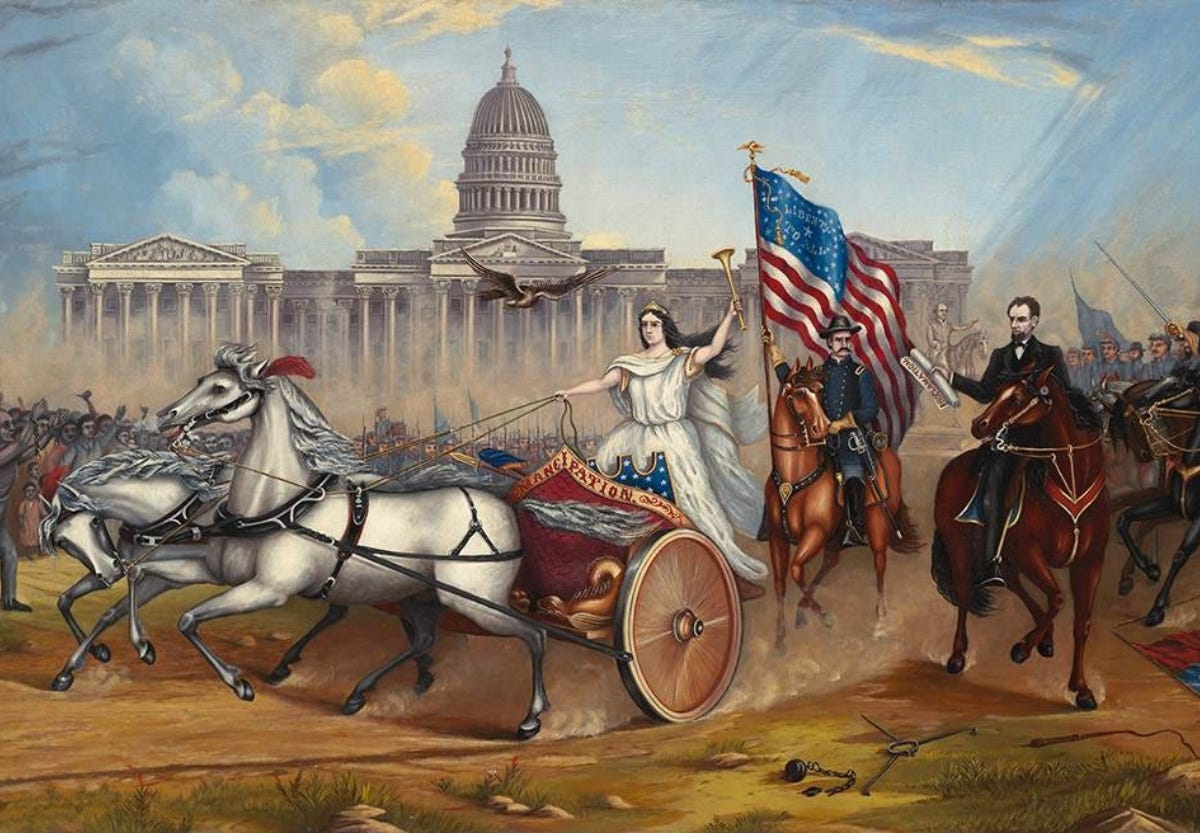
The Emancipation Proclamation completed the transformation. Lincoln issued it on January 1, 1863, as a war measure under the law of armed conflict, freeing slaves in areas still in rebellion and authorizing the enlistment of Black soldiers. The constitutional theory was that as Commander-in-Chief, Lincoln could seize enemy property in wartime, and slaves held by disloyal owners constituted enemy property under the dual theory ratified in The Prize Cases. The argument worked as a wartime measure but exposed itself to a serious post-war problem: if the Proclamation rested on belligerent rights under the law of war, those rights would expire when the war ended, and the constitutional status of freed slaves would revert to whatever the prewar Constitution had been read to permit. The war, therefore, produced a constitutional inversion. Before 1861, the Constitution had been used legally to do things that ran counter to American values, with full institutional sanction. During the war, Lincoln bent the Constitution to advance American values, often without clear textual authority and sometimes in direct defiance of judicial rulings. The original document had reached the limit of what interpretation could repair; only amendment could close the gap.
Reconstruction and the Attempt at Alignment
The war ended at Appomattox in April 1865 with the Union militarily victorious. Lincoln’s assassination five days later left the constitutional rewriting of the country to Congress, where Radical Republicans now had the votes and the political will to complete the inversion Lincoln had begun. The Thirty-Ninth Congress acted as what Jill Lepore has called a “second constitutional convention,” producing three amendments that together constitute the most comprehensive judicial repudiation in American constitutional history. The Thirteenth Amendment abolished slavery. The Fourteenth Amendment directly overturned Dred Scott’s citizenship holding by guaranteeing that “all persons born or naturalized in the United States, and subject to the jurisdiction thereof, are citizens of the United States and of the State wherein they reside,” and went further by guaranteeing equal protection of the laws, due process against state action, and congressional enforcement authority. The Fifteenth Amendment prohibited the denial of voting rights based on race, color, or previous condition of servitude. The three amendments did not merely correct individual antebellum errors; they transformed the constitutional architecture by writing the Declaration’s promise of equality directly into the text for the first time.
The Citizenship Clause of the Fourteenth Amendment was the most precise repudiation. Taney had held that no person of African descent could be a citizen of the United States; the Fourteenth Amendment provided that everyone born on American soil and subject to its jurisdiction was a citizen, regardless of race or ancestry. The clause was drafted with Dred Scott explicitly in mind, and its language was designed to make the kind of historical-political argument Taney had constructed legally impossible going forward. The Equal Protection Clause then extended the repudiation by binding state governments to a constitutional standard that the antebellum order had left entirely to state discretion. The Constitution was no longer neutral on the question of equality; it required it, and Congress was given the authority to enforce that requirement through legislation.
The text had been rewritten, but the political coalition that rewrote it was already coming apart. The same Congress that had passed the Fourteenth Amendment could not bring itself to convict the man who had led the rebellion against it, and the Jefferson Davis treason case became the first illustration of how quickly the new constitutional order would be abandoned in practice. Davis had been captured in May 1865 and indicted for treason, but the prosecution stalled for nearly four years over questions of venue, jury composition, and the legal effect of Section 3 of the Fourteenth Amendment. The case was never tried. On Christmas Day 1868, President Andrew Johnson issued a universal pardon for all participants in the rebellion, and the prosecution entered a nolle prosequi. The federal grand jury that had considered the Davis indictment in May 1867 included six Black men out of eighteen jurors, the first time in American history that Black citizens had served on a federal grand jury, and the symbolism of that moment captured the constitutional transformation more sharply than any verdict could have. The text had changed; the political will to enforce the text was already eroding. By 1877, the disputed Hayes-Tilden presidential election would produce a political bargain in which Republicans agreed to withdraw federal troops from the South in exchange for Democratic acceptance of Hayes’s inauguration, ending federal Reconstruction entirely and dissolving the political coalition that had sustained the Reconstruction amendments.
Conclusion: The Constitution Remade and the Alignment Deferred
The antebellum order was not, fundamentally, a project of constitutional fidelity; it was a project of preserving a racial and economic hierarchy that the Declaration of Independence had condemned and that the Constitution had been engineered to accommodate. Constitutional argument was the instrument through which that hierarchy was defended, not the reason it was defended. Jackson invoked the Constitution to justify ignoring Worcester, but the actual stake was Cherokee land and the political coalition that would benefit from its seizure. Taney invoked the Constitution in Dred Scott to deny citizenship to Black Americans, but the actual stake was the survival of slavery as a national institution and the slaveholding class that depended on it. Even Story, who genuinely believed himself bound by the Fugitive Slave Clause, was operating inside a constitutional structure whose function was to protect the property interests of slaveholders against any moral or legal challenge to their authority. The promise of equality was bent because the hierarchy required it. The Constitution was the language in which the bending was justified.
Lincoln answered the contradiction in the opposite direction. Faced with a constitutional framework that had been engineered to protect a social order incompatible with the Declaration’s promise, he bent the document rather than the promise. He suspended habeas corpus without congressional authorization, imposed a blockade before war had been declared, defied a sitting Chief Justice, and issued the Emancipation Proclamation on constitutional theories that had no clear textual foundation. The original Constitution could not be read straightforwardly to authorize what he did, but the values he was trying to preserve could not be honored any other way. Reconstruction then completed what Lincoln had begun, writing the Declaration’s promise into the constitutional text itself and dismantling the legal architecture that had sustained the antebellum hierarchy. The Constitution that had given inequality the force of law in 1787 now contained explicit guarantees of equality, due process, and voting rights. The promise had finally been written into the law meant to protect it. The political will to enforce that promise, however, would not arrive for nearly another century, and the alignment achieved in text in 1868 would not be meaningfully achieved in fact until the civil rights revolution of the 1960s.